From Oracle DBA to Postgres contributor with Karen Jex
Download MP3CLAIRE: 00:00:05
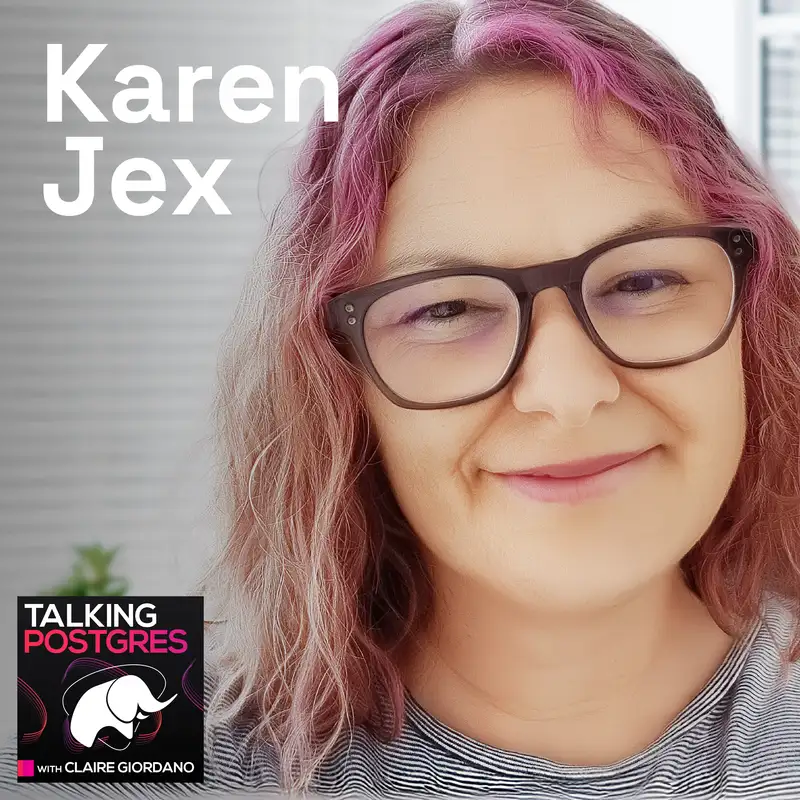
Welcome to Talking Postgres. This is a monthly podcast for developers who love this database. I'm your host, Claire Giordano, and in this pod, we explore the human side of Postgres databases and open source, which means why do people who work with Postgres do what they do, and how did they get there? I want to say thank you to the team at Microsoft for sponsoring today's community conversation. And, drumroll, today's guest is Karen Jex. Karen is a senior software engineer at Snowflake, which she formerly worked at Crunchy Data, which was acquired by Snowflake in 2025, and she's officially recognized as a significant Postgres contributor. Karen serves on the organizing team for PGConf.EU 2026, and she leads the diversity committee for PostgreSQL Europe as well. And she has worked in databases since 1998 and in Postgres since 2019. She's a frequent Postgres conference speaker and talk selection team member as well, a mountain biker. I think mountain biking might have a lot to do with why she lives in the country she lives in. And with that, I want to say welcome.
KAREN: 00:01:17
Thank you, Claire. It's a real pleasure to be here. I'm really happy.
CLAIRE: 00:01:24
Today's topic is from Oracle DBA to Postgres contributor. And I actually, as we were discussing title ideas and episode focus, I didn't realize that you were an Oracle DBA once upon a time.
KAREN: 00:01:41
For about 20 years.
CLAIRE: 00:01:43
Wow. OK, so how did you, let's start with that. I guess we're not gonna get to Postgres for a while, but hopefully we'll get there soon. How did you get started in databases? What was that path?
KAREN: 00:01:55
I like quite a few things in my career completely by accident. So I did a maths degree. And I actually was going to start doing a PGCE, which is teacher training in England. But my parents were both teachers, and we had various other family members who were teachers, and I saw what it did to them, basically, and decided that I really, really didn't think I could do that. So I had to choose something else to do. And at the kind of last minute, I thought, actually, I'm going to do a software development MSc. So I signed up for a software development MSc, and part of that was database theory, so relational databases, data modeling, data flow diagrams, that kind of thing. And that was my favorite part of that course, but I still didn't have any idea about what kind of jobs existed in the world of databases? So then when I started applying for graduate jobs, out of that, I applied for the graduate IT scheme at Barnardo's, the children's charity in England. And they did aptitude testing.
KAREN: 00:03:26
So as well as interviews, we were sat down in a room to do a whole series of aptitude tests, and they came back from those saying, Well, we think you'd be a really good database administrator. We'd like to offer you a job as a database administrator. And then I had to go back to my dad, who was in IT, to say, what is a database administrator? Because Google didn't exist then. I couldn't just look up online what that meant. So he explained what it was, and I thought, yeah, okay, that sounds like the kind of thing I'd enjoy. And it must have been because they must have got it right because I carried on doing pretty much exactly the same thing for the next 20 years.
CLAIRE: 00:04:12
And was this all with Oracle in those early years, or in those 20 years, I should say?
KAREN: 00:04:18
Yes, so through my MSc, we didn't even have access to any kind of real databases, literally I used Access to create my original, like, first databases when I was studying, I didn't know anything about any other databases then. So when I started my first job as a database administrator, they sent me off to do all of the Oracle training courses. So I got my Oracle DBA certification, and I kept renewing that through the years, and we only had Oracle databases there. I think my next two jobs as a database administrator, again, it was just Oracle. There was a bit of SQL Server and a bit of Sybase kind of got mixed in somewhere along the line. But then, kind of back to Oracle. Yeah, till about 2019.
CLAIRE: 00:05:25
Okay, so what dramatic event in 2019 changed your focus on databases? Tell me there's a story there. Is there a story?
KAREN: 00:05:36
It's not necessarily a super exciting story, but it's another of those complete accident type things. So I, for seven years, I was working remotely for the company I used to work for in London, so I was contracting as a DBA for them. That was supposed to be a five-month contract. It was one of those that ended up being seven years. And then finally they couldn't justify keeping me on as a contractor in France when they were doing their things in other places. So I had to decide what I was going to do next, and I found a contract in France as a so-called database expert on a team. And it was actually on the project that was rolling out the smart meters, smart electricity meters across France. And that was all in Oracle. So I got that contract and I worked with the team on this project to roll out the smart meters across France, and then a year or two into that, they decided they were going to do a new project, and it was going to be in Postgres. Now I still, to this day, have no idea who decided Postgres because nobody on the project knew anything about Postgres.
KAREN: 00:06:55
We didn't know how to download it. We didn't know how to install it. We didn't know how to back it up. We didn't know how to put high availability in place. But they just said, Oh, well, you're the database expert. You can figure it out.
CLAIRE: 00:07:05
So, did it feel like it was a top-down decision? Like somebody decided either they wanted to go with open source or they wanted to reduce costs, or you never know why. You still to this day don't know.
KAREN: 00:07:19
I strongly suspect they wanted to reduce costs. But the reasons were never communicated. It was very much just a— This project's going to use Postgres, and deal with it, yeah, yeah. So I had to go and figure out what Postgres was and how to use it. And then as soon as I figured out how to use it, I had to then train the developers on Postgres, pretending that I was, you know, this Postgres expert. So yeah, it was good. It was good fun.
CLAIRE: 00:07:29
Deal with it. Go learn.
CLAIRE: 00:07:52
Now, you mentioned something about living in France and working remotely for that seven-year period back in those earlier Oracle days of your life. Why were you living in France? I think this might be where the mountain biker part of the story comes in.
KAREN: 00:08:07
It is exactly where the mountain biking part comes in. My husband and I have both always loved cycling and, yeah, all of our holidays and some of our weekends were spent finding places to do mountain biking. We lived in the southeast of England, which is very much not known for its mountains, not even hills, really. And then we came on a holiday to a town called Morzine, which is near where we now live, for a mountain bike holiday. And a couple of weeks after we got home and were driving on one of the UK motorways, we just kind of looked at each other and said, like, wouldn't it be great if we could just go back and live in Morzine, and I think by a year, just over a year later, we'd sold up in the UK. We'd quit our jobs and we bought the house in France and moved here.
CLAIRE: 00:09:06
Very cool. I can't imagine. I mean, you have some real mountains in the town that you live in. So when you go off and do or did mountain bike rides, I mean, you're not just talking about small hills, right? On these.
KAREN: 00:09:22
No, we're halfway up a mountain, basically. We live at 820 meters altitude, and then the mountain kind of, you can see it out of our window, out of my office window, you see the mountain. Yeah, so our village has its own little ski resort, so we can drive for five minutes up the road and go skiing in the winter, which is really cool.
CLAIRE: 00:09:46
That is really cool. I like it. And thank goodness that people can, I don't know, work remote these days in order to do this kind of thing, live in a beautiful place like that.
KAREN: 00:09:55
Yeah, well. When we first moved here, there was no broadband. So I did have to give up my job for a while. I couldn't work remotely. So I did several other things whilst we waited for broadband to be installed. Yeah, so I'm not sure, looking back, what made us think it was a good idea. Because we had no idea how we were going to support ourselves. I had a career that I really enjoyed, that I knew I was going to have to let go of for a little while. Yeah, it worked.
CLAIRE: 00:10:42
So you're working for this smart meter company, rolling out smart meters. Leveraging all of your Oracle expertise, that sounds like you had more than 15 years under your belt at this point. They decide, for some unknown reason, to switch to Postgres. You had to figure it out. You had to learn. And then what was your role? You were a DBA at that point still, then with Postgres?
KAREN: 00:11:08
Yes. So they called me the database expert, which was kind of... Yeah, it was really a DBA role, but supporting the project with whatever. Database knowledge, etc. they needed. Oh, that new project as well, they decided they were going to use Ansible to roll everything out that equally I had no idea about. So I had to not only learn how to install Postgres, but also how to make that work on Ansible so that we could automate the setup and everything. So yeah, that was fun.
CLAIRE: 00:11:50
So, do you remember any of those first impressions or first experiences with Postgres? What did you think of the documentation? Were you happy with the getting started materials? Did you, how did you discover the open source community and the conferences, or, I don't know, step me through that getting indoctrinated into the Postgres world.
KAREN: 00:12:14
So I started, yeah, I started with the Postgres docs, and that was— That was a pretty good experience for getting up and running with Postgres. The bit that I struggled with, and I think some people still struggle now, although it is getting better and people are trying really hard to make it easier, was then how to put things together, because I came from an Oracle world where everything's kind of bundled together for you. You don't just have an Oracle database. You've got your backup and recovery, you've got your replication, you've got your high availability, you've got everything built in for you, and I know that comes with a price, but fortunately I was never the one signing the checks. I just got to play with the tech. So from my point of view, that was great. So then with Postgres, I had to figure out that we don't have everything there in one place. You have to build it for yourself, you have to put all the different pieces together. So that was a real culture shock for me. And it took me a while.
KAREN: 00:13:20
You know, I managed to get my first databases up and running and being backed up and practice recovery. And then it took me a good while longer after that, I would say months, to fully get my head around things like high availability. Connection pooling, all the other things that go around it.
CLAIRE: 00:13:45
I actually was in New York City for Postgres Summit US a couple weeks ago, and I gave a beginner's guide talk about replication. And it was, the way I described it is it was the talk I wish I had seen when I first got involved with Postgres, because I felt like all the different types of replication were an alphabet soup, right? I mean, there was shipping and streaming and synchronous and asynchronous and... I, you know, logical and physical. [Yeah, logical and physical.] And so anyway, I just kind of set people through it to explain these things and tease them apart and realize there's really just two main forms of replication. But yeah, I think people have been improving that beginner's guide level information over the years. I think you would. [Yes, I think so.] But I don't know if we're 100% there yet. We're getting there.
KAREN: 00:14:43
I think we're getting there and we listen and we're trying to make it better.
CLAIRE: 00:14:48
Absolutely. Okay, so this was 2019 that you first started getting involved in Postgres. And I know there are people out there who work with Oracle today who are probably listening to this episode, and they have not yet started to build up their Postgres skills. And so as you reflect back on your experience, and I didn't prepare you for this question, so maybe you might decide, no, Claire, I'll send you some links after we hang up, after the episode is recorded. But are there any particular resources that you would point an Oracle person to say, you should do this or you should read that? Any favorites?
KAREN: 00:15:33
I did find, and I can't for the life of me remember what the link was, but I did find a guide that someone had written, which was Postgres for Oracle DBAs. And yeah, I can't remember where it was, but it was quite handy because it just kind of gave a— a kind of, oh, you know, if you know this mechanism in Oracle, then that's what it is in Postgres, and there were some things like that. Oh, there you go, Postgres. It's probably that one, yes.
CLAIRE: 00:16:07
Well, we'll put it in the show notes, whatever the right one is. It's, we'll, I'll talk to Karen after the show. We'll find the link and we'll include it. Because, yeah, I think it helps sometimes when people find a resource that's geared toward whatever the mental model is they're already familiar with, [Yes, exactly.] and then connects the dots from there. Okay, so when I met you were not working for that smart meter company. You were working for Crunchy Data as a solution architect, and you were 100% on Postgres at that point in time, right?
KAREN: 00:16:45
Yes. So it didn't take long after I discovered Postgres in 2019 for me to move completely to Postgres full-time. In fact, from January 2020, I was working with Postgres full time. So it was pretty fast.
CLAIRE: 00:17:07
One of the things I'm curious about is solution architect versus DBA. Those are two different, are they two different job titles for the same thing? Or are they two completely different roles? Because you've worn both hats.
KAREN: 00:17:23
Yeah, so I went first to being a Postgres consultant, so I was kind of helping people to— I always said that that was going from being a DBA to helping other DBAs. And then I moved into the solution architect role, and I loved that role at Crunchy Data because it was a hybrid role. I know that solution architect means different things at different places. At Crunchy Data, it was a hybrid role, so you did some Postgres consultancy, some joining in on pre-sales calls. A lot of kind of evangelism, I suppose, going out and talking about Postgres and meeting developers and, yeah, it was great because I just got to talk about Postgres, play with Postgres, and teach other people about Postgres. That was great.
CLAIRE: 00:18:28
And when you were wearing that role of helping other DBAs, which in the Postgres consultancy role, you had said at the beginning that you wanted to be a teacher. That kind of puts you in teacher mode, didn't it? I mean, did it end up scratching two itches at once, or?
KAREN: 00:18:47
Yes. Exactly that, because it's not that I don't like teaching. I do like teaching. I just saw what being in the education system done to my family and I didn't really want to do that. I love teaching people that want to learn. I love teaching things that I'm excited about. So yeah, not having a curriculum, but being able to investigate new things or write about things that I've discovered or things that customers have asked me, that kind of thing. And, yeah, create talks and training sessions and that kind of thing. It's perfect. So, yeah, absolutely.
CLAIRE: 00:19:25
At Crunchy, when you had this hybrid solution architect role, did you find it was hard to, I don't know, manage your time across those different areas of responsibility. Was that a challenge, or was it explicitly not a challenge because you were just reacting to whatever the customers needed or whatever the team needed? I'm just always curious about time management.
KAREN: 00:19:52
Yeah, time management is something that's still a work in progress for me. So yes, it was reacting to what customers needed at the time, but also things that I wanted to do. So my time management was just say yes to it and then find the time to do it, which isn't necessarily a healthy approach.
CLAIRE: 00:20:16
Did that mean some late nights or some weekends or some early mornings at times?
KAREN: 00:20:22
Oh, not early mornings. No, no, no, no, no.
CLAIRE: 00:20:24
Oh, not a morning person?
KAREN: 00:20:26
Not a morning person.
CLAIRE: 00:20:27
OK, so we're doing this recording and you and I are not in the same time zone. So it's morning for me, but it's evening for you. And you're saying you're perfectly happy doing this in the evening. You wouldn't have wanted to do it bright and early.
KAREN: 00:20:41
No. Yes. This is when my brain kind of seems to come to life and be happy to do things, yeah.
CLAIRE: 00:20:48
Got it. Well, I have an espresso in hand, so that that helps me function at this time of day.
KAREN: 00:20:53
I mean, that works too.
CLAIRE: 00:20:59
The title of this episode is From Oracle DBA to Postgres Contributor, and I think the thing that I want to get to is you obviously moved from Oracle to Postgres not through your own choice, but because it was forced on you. Hopefully you're ultimately happy with that forced choice, but you were still operating as a Postgres DBA, as a Postgres expert consultant, as a Postgres solution architect, at what point did you get involved in the community and in contributing to the open source project? How did that happen? Was there a single moment, a single phone call or a single conference?
KAREN: 00:21:48
So I think I was very, very lucky because I went to PGDay France in 2019, which was in Lyon, which was where I was working at the time.
CLAIRE: 00:22:02
I should point out that you speak French, like extremely good French, which is good because you live in France, so.
KAREN: 00:22:06
I do, yes. I live in France, so yeah, there's not really an excuse not to.
CLAIRE: 00:22:12
Because PGDay France is an all French-speaking conference, is that right?
KAREN: 00:22:16
It's a French-speaking conference, yep. Yep. So yeah, it was in Lyon that year, which is where I was working. So I was able to just go along, and some of my colleagues went as well, because we were all trying to figure out what this Postgres thing was and how we were going to work with it. And, excuse me, and Lætitia was one of the speakers there, Lætitia Avrot. So I only said a couple of words to her then. But I was able to go to PGConf.EU that year. And I met Lætitia again and said, Oh, I don't know if you remember me, but we met in Lyon, and she introduced me then to, I can't even remember who at the time because names and faces for me are a blur at the best of times. But she introduced me to so many people in the Postgres community that during that conference.
CLAIRE: 00:23:17
Can you remind me which city this PGConf.EU was in?
KAREN: 00:23:21
Milan, I think.
CLAIRE: 00:23:23
Okay, so that would have been 2019.
KAREN: 00:23:26
Yeah.
CLAIRE: 00:23:28
Awesome.
KAREN: 00:23:28
Yeah. Yeah, so that was amazing, to have somebody just say, oh, you know, you need to talk to this person and this person and this person. So I came away from that feeling as though I was part of the Postgres community, which was amazing.
CLAIRE: 00:23:49
But for some people, that would be like you would now have friends, have relationships, have stronger acquaintances, and you would just come to PGConf.EU every year. You wouldn't necessarily turn into a contributor. So something somewhere pushed you into making contributions. You started giving a lot of conference talks at Postgres conferences, sharing the expertise that you'd built. And I don't, I'm just curious. I want to know more. How did that happen?
KAREN: 00:24:22
It's a really good question.
CLAIRE: 00:24:24
By the way, I was there in Milan. I did not meet you, that at least. I don't remember meeting you in Milan. Do you?
KAREN: 00:24:33
I don't remember, no. No.
CLAIRE: 00:24:33
Uh-uh. Oh, good. I'm glad. That would have been embarrassing.
KAREN: 00:24:38
Because I think the next place I went was FOSDEM. 2019, 2020, that must have been, yeah, just before everything locked down.
CLAIRE: 00:24:47
And I was there too. But did we meet?
KAREN: 00:24:51
I think we did meet then.
CLAIRE: 00:24:53
No, we met at FOSDEM.
KAREN: 00:24:56
I remember, yeah, bumping into you walking between two buildings at some point, but yeah. Yeah, how did I actually get involved? I think some of it was that. I kind of came to that realization, because with Oracle I was just a user of the product, and all of a sudden I realized that there was this whole kind of community that could not just be a user of the product, but actually help to guide the product and the project and make it bigger and better. And so there was some of that, there was some of that kind of... Yeah, realization that actually there is this whole group of people working on the same thing, but I really can't remember. You know, when I started becoming involved. It can't have been much later than that because it's been quite a few years now that I've been doing things for. It's probably just because I can't say no. So if someone asked me to do something, I would probably say, yeah, why not? I can help with that.
CLAIRE: 00:26:08
Well, when I think of all the different types of contributions you've made to the upstream project, I'll enumerate some of them, and then I'm sure I will miss some because I do not have a list in front of me, so this is all from memory. But I know that you served on the board of PostgreSQL Europe for a while. I know that I served with you on the PGDay Chicago talk selection team a number of several years ago. That must have been at least three years ago now. You've served on program committees for PGConf.EU and probably several other conferences as well, probably FOSDEM PGDay and FOSDEM, and I'm certain there are more. You serve on the— actually, you lead the Diversity Committee. I did mention that earlier for PostgreSQL Europe.
CLAIRE: 00:26:58
Organizing committees like PGConf.EU as well. So there's, I think, and then you've been a speaker. And what I think is so cool about your conference talks is you speak not only at Postgres conferences, where you would expect to have users, but you also speak at app dev conferences like DjangoCon, or I'm not sure if you've ever done a PyCon, but I know you've keynoted DjangoCon one year.
KAREN: 00:27:26
I did. That was a really proud moment.
CLAIRE: 00:27:30
So, and I think it's fabulous to get people in the app developer community who sometimes are a little bit far removed from the underlying database, right, with the ORM stuck in between, and maybe they don't fully understand it. Maybe they want to understand more, but they've never gotten to that point. And so anyway, I love that you're also teaching people in those communities as well.
KAREN: 00:27:58
Yeah. I really, really love going into those communities. Yeah, so I went to my first DjangoCon in 2022. Yeah, and that was actually Craig Kerstiens who suggested that I might want to submit a talk and go and speak to the folks at DjangoCon. And so I did that in 2022, and I was really excited to get a talk accepted. And I enjoyed that conference so much. I enjoyed the— just the feeling from the audience, the questions afterwards, the interactions with everybody, and I've actually managed to go to DjangoCon, apart from this year, every year since then. So I did 2022 through to 2025. Because they just, they love Postgres. The Django community is so enthusiastic about Postgres, and they want to learn about it. So yeah, you said they're often quite removed from the database, but they want to know what's going on. So it's been really fun to write talks specifically for them to help them understand the things that are useful to them.
CLAIRE: 00:29:11
Yeah, when I worked at Citus Data, which is a Postgres startup that got acquired by Microsoft back in 2019, and I worked with Craig Kerstiens as well, we used to go every year to PyCon and have a booth and answer people's questions. And the affinity, the love, the affection, the interest that Python developers have for Postgres just overwhelm me every single time. We would have standing room only at our booth and deep lines of people wanting to come and talk and discuss Postgres questions, and it was pretty cool.
KAREN: 00:29:49
Yeah, I love it. It, yeah, it warms the heart. And then I went to a couple of Ruby conferences as well over the last couple of years, and I got that same feeling there as well. It was just so lovely, yeah.
CLAIRE: 00:30:10
So, PGConf.EU, we just talked about you serving on the organizing team and past program committees. I don't know if you're on the program committee this year or not, but I know you have been in the past. It's happening next week in Valencia, Spain. So for those of you listening, if you're not familiar, PGConf.EU is the largest in-person Postgres conference of the year, and it rotates around different countries and cities in Europe. So every year it's in a different location, and there's always a bit of anticipation in terms of where's it going to be next year. They try to organize it a year in advance. Sometimes it's only 11 months in advance, but as soon as they get the contract signed. And so this year it's in Spain, so it should be warmer than it was last year in Riga. And are you, I know you're giving a talk. I looked it up. You're giving a talk on tuning Postgres for analytics.
KAREN: 00:31:00
Yes.
CLAIRE: 00:31:11
And I will do my darndest to be there. Looks like Tuesday at five o'clock, so I am going to try to be there, see what you've been up to lately.
KAREN: 00:31:22
Just before the social event, so hopefully everybody will want to be around.
CLAIRE: 00:31:27
There you go. Is there anything in particular that you are super looking forward to next week? Anything I need to pay attention to.
KAREN: 00:31:39
Do you know what? I am so embarrassed to say this. I have not properly looked at the schedule this year, at the talks on the schedule, because I was really glad I had Samed helping me on the program committee last year. So I was the chair and he was helping me, and he did such an amazing job that I suggested delegating it to him this year. So he's taken it on this year, and he's done, from what I can see, an amazing job. And I do remember having a quick look through to see who was on the schedule and what was going on. But I haven't, since then, I've been so busy organizing PGConf.EU that I haven't actually sat down to work out which talks I want to go and see when I'm there.
CLAIRE: 00:32:27
So you don't have a plan yet, is what you're saying.
KAREN: 00:32:30
Yeah, pretty much, yeah.
CLAIRE: 00:32:31
Okay, that's fine. I mean, there's two ways to do it, right? One way you show up with your calendar pre-booked or a spreadsheet that tells you what, where to go when, or you just at the start of every session, you just look at your phone and you roll the dice, and that works too. It's, I will say that at PGConf.EU, unlike FOSDEM, where you sometimes have to get in line in the queue for a particular talk up to an hour before, or you will not get a seat in that talk. PGConf.EU, you can almost always squeeze into a room, which is not to say the rooms aren't full. It's not to say it's not a large conference, but the rooms are big enough. You know, and there's standing room in the back usually. FOSDEM, because it's on a university campus, those rooms are small, and they're very strict about capacity limits, so.
KAREN: 00:33:27
Yeah, no, I like to go to every conference with a full plan of exactly where I'm going to be where, but this next week isn't working out like that, so.
CLAIRE: 00:33:37
But you still have a couple of days.
KAREN: 00:33:40
I do have a couple of days, yeah. But there are so many other things that I want to do as well, and so many people that I haven't seen this year that I want to talk to, and so I'm going to have to be quite selective, I think, about which talks I go to.
CLAIRE: 00:33:54
Okay, so we should talk about the elephant in the room, and I'm not talking about a Postgres elephant, although immediately as I said that, I'm picturing a Postgres elephant. Oh, here, I'm holding one up. Nobody can see it because this is an audio podcast. You were originally supposed to be on this podcast at the end of last calendar year, at the end of 2025.
KAREN: 00:34:20
No. I was, and I know exactly which date.
CLAIRE: 00:34:23
We had the sound check done. Everything was set, graphics were ready, we were prepared to go, and then you had to cancel.
KAREN: 00:34:36
Yes. Yeah, that was a bit of a shock last year. I remember I had been in touch with you, I think two days prior to say, Claire, I don't know how this is going to go because things are looking a bit weird. And then yes, the day that we were supposed to record was the day that my husband was diagnosed with leukemia. So since then, he's okay at the moment, so I will say that straight away before I go into the rest of the story: he is in remission. The cancer's in remission. He's finished his intensive treatment, and we're now kind of moving on to the maintenance phase. So, yes, we get that bit over with first before I say anything else. And I can talk about it now without getting emotional, but yeah, it was for months. It's been, it has been really tough. So yeah, 10 months of intensive treatment.
CLAIRE: 00:35:35
And I know you had to step back from a lot of things and just focus on supporting your husband and supporting the family, which was, I think, a big burden to bear. I think that's probably why you stepped back from the Postgres nonprofit board in Europe. [Yes. Yep.] I'm assuming that Snowflake was supportive.
KAREN: 00:35:54
Extremely supportive, yeah.
CLAIRE: 00:35:59
I know that I, we were going to see each other at FOSDEM. We were going to be celebrating at FOSDEM. [I was really excited.] And obviously you didn't come to that conference either and just hunkered down to help your husband.
KAREN: 00:36:14
Yeah, very much. So I resigned from the PostgreSQL Europe board. I think in January. After hiding away, the first five weeks my husband was in a sterile room, so we could visit, but only two people could visit at a time and only for a certain amount of time, and it was, you know, behind so many... Buzzer, you know, doors with buzzers and all that kind of thing. It was, yeah, it was quite stressful. And so he was in there over Christmas and New Year. So for the first five weeks, I just, I didn't do anything else. I didn't speak to anybody else really. And then I gradually managed to get back to work, and I needed to work because I needed something to focus on. I needed some kind of structure to my day. But I didn't travel because I needed to be close to home. You know, going backwards and forwards to the hospital and that kind of thing. I think I looked back earlier at doing kind of ten, twelve, sometimes even more trips to do conference talks each year. This year, I did go to EuroPython in Krakow in July, which was amazing because EuroPython is one of the conferences that I had wanted to go to for ages, and Mike was well and he was in between treatments, so I was able to go, which was brilliant. But other than that, PGConf.EU next week will be my first conference. It's been an interesting year.
CLAIRE: 00:38:01
I am very, very happy for you and your family that he's in remission. And that we're having this conversation instead of...
KAREN: 00:38:12
Yes. Yes, absolutely.
CLAIRE: 00:38:16
And I get to see you in person next week, which is, I'm, I know a lot of people are gonna be, because you haven't been as visible and as present in the community in the last year, you're probably gonna, get to your hotel room at night and just be exhausted because you're going to get pulled in a million directions. We're all going to want a little bit of Karen time, and so... Ah. Hopefully I can.
KAREN: 00:38:43
No, I am. I am really looking forward to seeing everyone.
CLAIRE: 00:38:48
Or buy you a tea or something like that.
KAREN: 00:38:50
Yes.
CLAIRE: 00:38:52
Okay, so PGConf.EU is expected to be bigger this year than it was last year. Is that something?
KAREN: 00:39:00
Yes.
CLAIRE: 00:39:02
And for the very first time, it's not being held in a hotel. Because there's this really interesting thing, like these price points, you know what I mean? Hotels can only get so big in terms of the size of the conference. But then after hotels, what's the next step? And is it too much bigger? Is there an in-between? I don't even know how you found this conference center, but... It'll be different.
KAREN: 00:39:29
It will be different. I think there's enough of the kind of usual PGConf.EU vibe that it'll still feel familiar to people. And there is the hotel just kind of next door to the conference center, so hopefully that will kind of feel a bit like an extension of the conference center. So yeah, but it's a new experience. It's been a huge learning curve for the organization team, of course, because you've got your checklists for how things work in a hotel venue, and obviously the checklists are all different, aren't they, once you move on to a different kind of venue. But yeah, I'm excited about it. I think it'll be good.
CLAIRE: 00:40:17
Now that your husband is doing better, you're coming to PGConf.EU, you're giving a talk there. Are you also submitting to other CFPs that are open now? Is that something that you're ready to do, or are you going to be more selective this year and only submit to a few places? Have you decided yet?
KAREN: 00:40:38
I've realized that although I've missed people this year, and I want to do more than I have this year, it's not sustainable for me to go back to traveling more than once a month. And it's made me realize that I don't feel as though I need that level of, you know, travel and that kind of thing. So I think I'm going to try and do maybe four to six conferences next year. And just, yeah, be selective about the ones I do. I would love to go back to DjangoCon and EuroPython if I can. Yeah, I just, I really love bringing more Postgres knowledge to those communities and selfishly, I just love interacting with them. I love being there. So they would be good. PGConf.EU is a must. And aside from that, I haven't decided yet.
CLAIRE: 00:41:38
Of course. Okay. Well, I know that FOSDEM PGDay, so FOSDEM PGDay is technically a fringe event. Around the weekend of FOSDEM, there are lots of events, like the Thursday and Friday before, or the Monday and Tuesday after, and FOSDEM PGDay always runs back to back in Brussels with FOSDEM itself, but the exciting thing this year is it's going to be a two-day pre-event, and I don't think the CFP is open for that yet. And then, of course, hopefully there will be a Postgres devroom at FOSDEM this year. There was not last year, but hopefully we'll find out. I don't think the decisions have come out yet on that.
KAREN: 00:42:21
I think the call for devrooms and booths is still open at the moment.
CLAIRE: 00:42:27
Okay, cool. So I know that that's on the table. PGConf.dev is happening in Montreal this year in May, and that is, I'm not telling people where Karen is going to submit. We didn't pre-discuss this. I'm not giving hints. I'm just talking about CFPs that I'm excited about. And then PGConf India's CFP closes tomorrow, and I'm still trying to decide whether to submit. I've been two years in a row, and it's got—it's a really wonderful conference with a lot of energy and a lot of excitement around learning more about Postgres. It's just a very long flight for me, so I haven't decided yet if I could, you know what I mean? If I get accepted, can I handle that flight again? And then we are doing POSETTE again this year. This is going to be the sixth year, so POSETTE: An Event for Postgres, and the save the date just went out, and it's on the 30th and 31st of March next year. So those are the CFPs that are on my mind, at least.
CLAIRE: 00:43:43
We talked for a second about the keynote you gave at DjangoCon a couple of years ago, and I'll make sure to include a link to that in the show notes. But I think the title was, When I grow up, I want to be a database administrator, said no one ever. And I'm just curious what the reception was like to that.
KAREN: 00:44:08
It was really good, actually, and more to the point, I really enjoyed giving it, because it allowed me to be a bit self-indulgent and talk about how I became a database administrator, and the fact that even though my dad taught me to count in binary when I was a toddler, he bought me my first computer. Well, he built me my first computer when I was, I think I must have been about nine or something like that, and taught me to program in BASIC and... You know, I was obviously a bit of a geek, and I did a maths degree and software development MSc. I didn't even consider being a database administrator. I didn't know what a database administrator was. It's just not something that's on most people's radar. And even if it is on people's radar, it's not the kind of glamorous, exciting job that people dream of. So I just, I really like the idea of doing a kind of tongue-in-cheek: you know, these are all the things that I love about databases and about being a database administrator, and let me try and share some of that love with you.
CLAIRE: 00:45:32
I think it's so cool that you took that aptitude test shortly out of university, and it ended up spitting out that you should have this job type. I'm very surprised that an aptitude test even focused on the niche world of being a database administrator, but clearly it's been a good fit for you in those earlier years of your career.
KAREN: 00:45:56
I feel so lucky that they did those tests because, I don't know, I might never have discovered databases otherwise, [Who knows?] but clearly it was a good fit for me because I wouldn't have carried on being a database administrator for 20 years and then staying in the world of databases for however many years longer, yeah.
CLAIRE: 00:46:19
And now that you're at Snowflake, I imagine your role has changed. I can see that your job title on LinkedIn has changed.
KAREN: 00:46:22
Yes. It has.
CLAIRE: 00:46:28
And you are now a senior software engineer. So what is, what does that mean? How's your focus different now?
KAREN: 00:46:36
So this is really exciting for me, actually, because I've already said how much I loved the solution architect role at Crunchy Data. But I was starting to feel as though I wasn't getting enough time to be kind of properly technical. Because I was being pulled in lots of different directions. And then the solution architect role at Snowflake is completely different, I think. The solution architect role at Snowflake is more of a kind of consulting type role. And then the role that most of us were being moved towards was solution engineering, which is more of a kind of pre-sales, technical pre-sales kind of role. And I'm quite happy to do some pre-sales, but it's really not where my interest lies. It's not the kind of thing that excites me. What really excites me is building things or helping to build things and playing with things and teaching other people about them. And so I've been really fortunate that I have moved over to the engineering organization into the Postgres extensions team at Snowflake. So I'm working with the folks who create pg_lake.
KAREN: 00:48:17
And I'm doing a kind of a hybrid role there where I am doing some development. I'm helping to develop internal tooling and also doing all of the advocacy and that kind of thing that I was doing before. So kind of picking and choosing my favorite bits of all the jobs really, so, yeah, it's great.
CLAIRE: 00:48:48
Well, I think one is lucky if you land in a place where you get to do the favorite bits of your job. Not everybody gets that, so.
KAREN: 00:48:58
Yeah, no, I feel very fortunate.
CLAIRE: 00:49:03
I mentioned POSETTE a second ago, and as I did it, I typed in a quick search to remind myself of your past POSETTE talks. You've given three POSETTE talks over the years.
KAREN: 00:49:15
Oh, have I? I remember two.
CLAIRE: 00:49:17
Yeah. Okay, so, well, okay, technically one of them was Citus Con, but I consider, remember how we renamed Citus Con: An Event for Postgres to be POSETTE: An Event for Postgres. So anyway, it's three. And one was about multi-tenancy, one was about how you don't need a database backup policy, and one was about managing Postgres at scale: challenges, tools, and techniques. So I want to include at least one of these in the show notes for the episode. Do you have a favorite? You've given so many talks in so many places. How could you recall what the favorites are?
KAREN: 00:49:55
Yeah, no, I do quite like the one with cakes in.
CLAIRE: 00:50:02
That, that was... wasn't that 'You don't need a database backup policy'? Is that the one with cakes?
KAREN: 00:50:07
Cakes, I think, was multi-tenant databases.
CLAIRE: 00:50:12
Really?
KAREN: 00:50:13
Because obviously you would describe multi-tenant databases with cakes. But no, you don't need a database backup policy, I quite like. I had an explosion in there, so it's all good.
CLAIRE: 00:50:23
Yeah, I'm looking at the slides right now. There are no cakes in the backup policy. Okay, so it's got to be multi-tenancy. All right, well, I'll roll the dice and I'll include one of them in the show notes in case anybody's curious. All right, so one of the things I'm really curious about is how AI and LLMs are changing your work, are changing your workflows, are changing how you do your job. If you have any favorite tools or favorite new things that you've tried, as a guest on this show, I had Simon Willison on a couple of times, and he's kind of world-renowned in the space of AI and kind of on the cutting edge of all the latest models, not just from the frontier companies, but also open weight models as well and things coming out of China. And it's always a blast for me to kind of hear from him, but he's so advanced, right, that I'm always pulling it back like, okay, okay, what should the rest of us do? But I am curious how it's changing your job, and if we can compare notes.
KAREN: 00:51:42
Yeah, I did listen to Simon talking about typing in the shower because he suddenly had an idea to rewrite something about, and no, I'm not quite doing that yet. I think that I'm probably around the place that a lot of people are, which is trying to work out exactly where it fits in my day-to-day. So I'm using it a lot. I'm using agents to help me, particularly with creating my internal tooling. And I'm still trying to get that balance of how much do I delegate to the agent and how much do I want to keep hold of myself. And I imagine that there are probably a lot of other people in that situation. I'm not. I'm not comfortable at the moment with just sending off a whole team of, you know, 20 agents to just kind of get on with things on their own. I still very much like to handhold and make sure that I'm giving loads of feedback and reviewing things and also trying to make sure that I don't forget things, that I don't forget how to do things, I don't forget how to...
KAREN: 00:53:04
You know, how to design a spec for something, or not necessarily the nitty gritty details of coding, but yeah, just the actual thinking and reviewing and going through that kind of iterative process. So yeah, it's one of those things at the moment that I think I'm constantly thinking about and constantly trying to work out what's the right balance here, what's the right amount to be doing myself, what's the right amount to be delegating to agents?
CLAIRE: 00:53:44
So I, about three or four weeks ago, hit an inflection point. And tried something new, and I was absolutely blown away by how much more efficient. And it has made me and how it has unblocked some of my work. So I'm just going to tell you what I did, and then you, if you're not already doing it, you should totally try it. And for those of you who are listening who are not already doing this, you should totally try it. When Adam Prout was on the show back in, I think he was a guest in May, Adam is a distinguished engineer at Microsoft. I almost said at Sun Microsystems. Wow, things, the old habits die hard. No, he's a distinguished engineer at Microsoft, and he's the lead architect on Azure HorizonDB. And he was talking about how at that point in time, and of course things have changed since May, but he thought of the agents as typists for him, and that he didn't type code anymore, right? He used voice to interact. And I haven't been using voice all this time. So I know that Wispr Flow is really popular. I have another friend who strongly recommends FluidVoice because it runs locally on your system, and so it's super fast and it's open source. And of course, you can just use the microphones and the voice capabilities that come with frontier models. But I had not been using voice.
CLAIRE: 00:55:12
And I started using it. And oh my gosh, it is so much faster than typing. Typing and backspacing and correcting and typing and refining and rethinking. I literally will just ramble to the agents, and it'll capture everything that I want. It pulls it out in an organized manner and goes off and does the work. And so all of my instructions, all of my prompts, all of my ideas are so much faster. And here's the thing that blew me away. I had a particular proposal that I needed a stakeholder to buy into inside of Microsoft, and I wanted to make sure that the wording was particularly strong, powerful, influential, persuasive. I wanted persuasive. I had the ideas in my head, and normally what I would have done is I had these four persuasive points, I would have typed them in, and then I would have actually sent it to an LLM to say, Is there anything here that's ambiguous or confusing? To ask it to be an editor, in other words. And in this case, I thought, well, let me just try voice. So I enumerated the four items, but I rambled a bit and I meandered and I went over here and there and everywhere, and— It was able to pull out another, more compelling point out of my ramble than I had articulated.
CLAIRE: 00:56:34
And it was more compelling than anything else, and it won the argument. And I was just surprised that, wow, I hadn't even realized how important that was. It was in my thoughts, but I hadn't elevated it to be like the crux of the matter. Does that make sense? So anyway, I use voice now, and I'm so much faster.
KAREN: 00:56:56
That's really interesting to listen to, and as you were telling me about that, I was thinking, but that wouldn't work for me, I don't think, because I work so much better in writing. And for me, the act of writing something, and changing it, and rephrasing, and cutting a bit out and putting something in, that's how I kind of process my thoughts. For me, doing it by voice just wouldn't, I don't think would work for me.
CLAIRE: 00:57:30
I would have said that to you a month ago. I've always been a firm believer that writing is thinking. I took a year off to write a book at one point in my career. I think of myself as a writer. I still do my own writing. I don't outsource writing to any LLM. I strongly believe in authentic voice and, you know, that human element, but I am embracing voice as a way to get certain types of work done faster, and I've been blown away at how much more efficient I am, so, I don't know. Just planting the seed.
KAREN: 00:58:10
Okay. I will give it a try and let you know.
CLAIRE: 00:58:13
All right. I want to make sure that we have covered the promised topic of this episode, which is from Oracle DBA to Postgres contributor. Actually, in that FOSDEM 2020, when we were together in Brussels, I think the talk that I gave there was on different ways that people can contribute to the Postgres community. It was like Fibonacci spirals and 21 ways to contribute to Postgres beyond code. Because the project, of course, has documentation and translations and meetups and podcasts and blog posts and conference organization. And I mean, there's so many ways to contribute. Diversity committees, core team, protecting the trademark, right? There's a lot of different things there. Is there anything that you think we should talk about becoming a Postgres contributor that would be useful for someone who's listening, from your experience?
KAREN: 00:59:20
Yeah. As I was saying, I was very lucky that I was taken under the wing of somebody. So Lætitia really took me under her wing at that first PGConf.EU that I went to, and I think that— That's really helpful to have someone to kind of say, you know, oh, maybe you should talk to this person about this and someone just to kind of point out who's who a little bit. And I know that there have been talks recently. I know you've done talks. I know Valeria has done talks about, I think she did the— Is it the Postgres community in a nutshell? I can't remember the exact name of her talk. So there have definitely been a lot of people trying to make it clearer who does what and how people can get involved. And then I'm really, really excited. I think I've used the word excited a lot today because I am really excited about lots of the things going on at PGConf.EU. We've got a buddy program at PGConf.EU.
CLAIRE: 01:00:22
Oh, so people can sign up to be partnered with someone who's more experienced at the conference?
KAREN: 01:00:29
Yes, and I think we've got thirty-five pairings or something like that. I mean, I might be giving a completely wrong number, but it was really, really nice to see how many people wanted to sign up as a buddy, so to share their knowledge of the Postgres community with someone and, you know, just be a friendly face at the conference, because I've been to conferences years ago where I didn't know anyone and I was just kind of looking around the room wondering if I dared approach anybody. And I'm sure I'm not the only person that's felt like that. So yeah, the fact that we've been able to pair people up, so someone that's new or just shy or traveling on their own to the conference or just doesn't yet know anyone in the community, they'll have somebody that they've been paired up with, who they can meet up with, they could have a coffee, they could, each pairing will kind of decide what works best for them, but yeah, we're trying to put things like that in place so that people actually have those little ways into the community.
CLAIRE: 01:01:43
I'll try to dig up a link to that talk you mentioned that Valeria Kaplan gave, talking about ways to contribute to Postgres. And I know that this year there's also another, I think it's the second year of this experiment where there's going to be a community day. So after the three-day EU conference ends on Friday, there is the PGConf.EU community day, and there's all sorts of longer, deeper dive sessions there, right? So I need to register. I haven't registered yet. Oh gosh, I hope it's not sold out yet.
KAREN: 01:02:14
Do it. I think there are a few places left, so I would do it too.
CLAIRE: 01:02:19
Okay, I better get with the program then.
KAREN: 01:02:21
But yeah, that should be a really good day. It was popular last year. We've swapped it, so last year it was on the first day. This year it's on the last day, and I know there were good reasons for that, and I can't for the life of me remember what those reasons were. But anyway, that's how it is this year. I think it's good to try both and see which works best for people in any case. And based on feedback, we can decide which one we do next year. But it's, we had quite a lot of people wanting to organize events for that. So each one is a half-day event. So I'm trying to remember, there are all sorts of different things. So there are working groups on Postgres education. There's stuff about Kubernetes. There is talk about an extensions ecosystem, observability, automation. There's all sorts. It's, yeah, it's great.
CLAIRE: 01:03:23
Now, are we going to have a Postgres 19 release candidate 1? Yes, we are. It looks like it's due out later this week. Obviously, GA isn't going to happen until November this year, mid-November-ish, I think. I'm looking at the latest dates. But release candidate 1 is targeting later this week. So that's very exciting. [That is exciting.] I think people who have worked extremely hard on the annual release will be happy to be so close to the finish line. I don't know if they'll be in a celebratory mood yet because it won't be over yet when we see each other next week, but...
KAREN: 01:04:04
And I suspect people that have written talks for PGConf.EU about Postgres 19 features may be feeling a little bit calmer about their talks if we're at that stage.
CLAIRE: 01:04:14
Oh, things are more settled in terms of the final contents of the release and all of that. [Yeah. Exactly.] So one of the cool things that happened to me in New York City, the annual PGConf New York City event, which was renamed this year, so it's now called Postgres Summit US, just happened, and Joe Conway, who serves on the contributions committee for Postgres, they've started giving out coins. There's always been coins for anybody who contributes to a release, and those are called challenge coins, and it's pretty cool. And folks are—there's a new one for each new release of Postgres, and people are always very excited about that. But there is also now a one-time significant contributor coin and a one-time major contributor coin. And so I received my significant contributor coin just two weeks ago in person, and I'm sure you haven't gotten yours yet, have you?
KAREN: 01:05:04
No.
CLAIRE: 01:05:14
Okay, but you are a significant contributor, and I'm sure that Mark Wong will have hopefully a coin for you when you get there. So anyway, it's just, it's kind of cool. There's something really special about recognition of work on an open source project. So, and since this episode is titled From Oracle DBA to Postgres Contributor, I thought it fitting to end with a thank you to you for all the work you've done for the Postgres project, to give you that physical thing to look forward to. And here, we're not on video on the recorded episode, but just so that those of you know.
KAREN: 01:05:25
That is cool. Yes.
CLAIRE: 01:05:57
Just so that those of you know how the sausage is made, we are on video backstage. It's just the video isn't recorded, which is good because I'm not exactly having a good hair day here. But I'm trying to dig up and show Karen the coin, and I guess I'll have to do it later. It's too hard to find it now. But I do thank you for everything you've done to contribute and are still doing. So the journey is not over yet.
KAREN: 01:06:26
It's not, no, it's a pleasure.
CLAIRE: 01:06:30
And thank you for joining us today on this episode. I really, really appreciate it. Glad you're here.
KAREN: 01:06:35
Thank you for inviting me. It's a fitting way to mark the kind of coming back to normal of my family life after the attempted recording last time.
CLAIRE: 01:06:54
Well, thank you to Karen Jex for joining us. And if you liked today's episode and you want to hear more of these Talking Postgres shows, you should subscribe on Apple, Spotify, YouTube, or wherever you get your podcasts. And please tell your friends too. Word of mouth is gold in the podcast world, and people generally, if they like the show, they end up being really appreciative of it. You can always get past episodes and get links to subscribe on the different platforms at TalkingPostgres.com. And transcripts are included on the episode pages on TalkingPostgres.com too. And a big thank you to everybody who joined the live recording and participated in the live text chat on Discord.
Creators and Guests