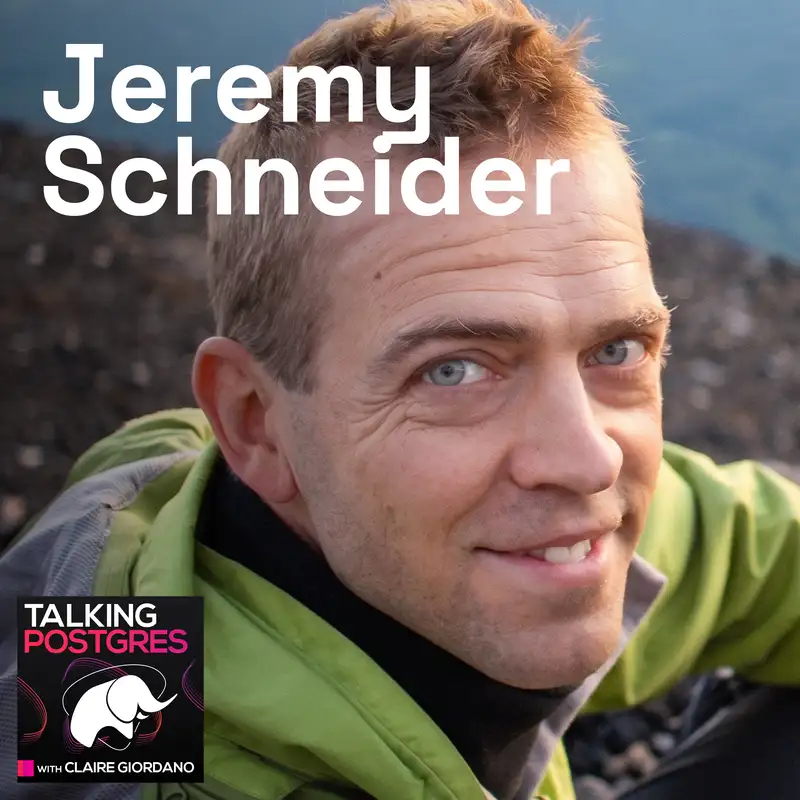
How I got started running a Postgres user group with Jeremy Schneider
Download MP3CLAIRE: 00:00:05
Welcome to Talking Postgres, a monthly podcast for developers who love this database. I'm your host, Claire Giordano, and in this podcast, we will explore the human side of Postgres databases and open source. And which means why do people who work with Postgres do what they do and how did they get there? I want to say thank you to the team at Microsoft for sponsoring today's community conversation. Now, today's guest is Jeremy Schneider. Jeremy is a Postgres database engineer. He currently works at GEICO, where he's helping to build a next-generation hybrid cloud database platform. And he formerly worked with Postgres at AWS. And before that, he spent about 15 years working with Oracle databases. Jeremy is a blogger, and he's co-organizer of the Seattle Postgres user group. He's author of a super useful poster that I'm sure we'll talk about called the Postgres Happiness Hints. And that's it. Welcome, Jeremy. [Thank you.] All right. So today's topic is how I got started running a Postgres user group. And so we're definitely going to spend a big chunk of time talking about local user groups in the Postgres community. But first, if you don't mind, I wanted to start with your origin story as a developer. And once we know how you became a developer, then of course, I'm going to ask you, how did you get started with databases? But let's start at the basic level. First line of code.
JEREMY: 00:01:41
All right. Well, I feel like we're breaking the rules a little bit because the name of the podcast is Talking Postgres, but my developer origin goes way back. My parents are actually visiting town.
CLAIRE: 00:01:53
Before Postgres.
JEREMY: 00:01:55
It does. We'll get to Postgres eventually, but if you want to know where it all started, I actually, it's funny, actually, since my parents were visiting, I asked my dad this morning to remind me. And my first line of code was all the way back when I was in high school. And it was because our neighbor, who was two houses down the street in rural Michigan, a guy named Scott Way, offered me a job while I was in high school. Let's see, he worked, had a small business in the automotive industry, and was willing to kind of hire me as a high schooler to do some programming because it was started out as a great summer job and that was kind of where it all started for me. I'm trying to even remember. I remember doing Visual Basic stuff. I remember writing part programs for CNCs, which were, if I remember right, computers attached to machining equipment. It's a long time ago.
CLAIRE: 00:02:58
What's part programming?
JEREMY: 00:02:58
So ages, ages ago. Oh, man. It's actually a lot like 3D printers today. But before we had 3D printers, when you were just like large scale industrial stuff. And I was like, I wrote this little program that would just upload the part programs.
CLAIRE: 00:03:11
Okay. All right. So, okay, but not every high school student can land a summer job as a developer. So does that mean you'd been playing around with programming and code in school or just at home?
JEREMY: 00:03:29
Yep, for sure. Yep, there were, you know, the computer classes at school and stuff. And I don't know. I mean, it's funny. Who knows? I was, you know, I was probably not writing, amazing programs. Yeah, I mean, this was a summer job as a high schooler. But it was the on-ramp. [Right, right, right.] It was what started things out.
CLAIRE: 00:03:51
And then did you study, did you go to university? Did you study more computer science at school? Or how did you go further than this summer job? Or did you walk away the summer job? Maybe you hated it and you didn't do anything with code for another five years.
JEREMY: 00:04:10
I, let's see here. I, you know, I always was interested in a bunch of things. So computers were always there along with a bunch of other things as well. So I did end up going to a university right out of high school. And I changed my major literally every semester for the first two years I was there because I couldn't make up my mind. I think I was an English major for a while. I was a computer science major for one of those semesters. And then at the end of two years, I ended up actually, I wouldn't say dropping out, but deciding not to continue. Ended up going back home, getting a job as a dishwasher at a restaurant. But I don't know. I was just doing all kinds of stuff. I did end up getting a job after eventually, after kind of coming back home with this, a company called the ASU Group, I remember, who funny, full circle, was in the insurance industry, doing another kind of programming job. And this is actually a fun part. So I had come back home, I got this programming job. And I remember working at this company in Okemos, Michigan. I still know exactly where the building is when I've gone back home. And they had, there's a bunch of fun things I did there. But they had literally this closet with a server sitting in the closet that I think a contractor had put together for this application. And on this server sitting in a closet, there was an Oracle database and nobody knew anything about this database at all. And I was just, you know, I was very curious, very interested in trying to figure things out. And that was just really, I was curious. I was, I wanted to try to figure this thing out and it was an opportunity to try to figure things out. And one of the things that I remember doing, this is probably my early twenties or so. So at one point, I figured out that the Oracle manuals, you could download them over the internet. And this is, let me think, time frame. This would be like early 2000s, right? So 2000, 2001, 2002. And I found where you could download. And my favorite one was Oracle had a manual called the Concepts Manual. And I figured out how to download that Concepts Manual. And I just remember for about two weeks straight, every night, there was this little coffee shop locally in town. It was this local Michigan chain. Originally was called Beaners. Later, they renamed it to Biggby. And I just go in the evenings and sit there. And I don't know what people thought, but I was sitting there with my laptop, just reading these PDFs. And I just was having a great time. The stuff that I was reading about the concepts of the Oracle database, and the concepts made it kind of walk through, how does the redo log work, just basic stuff, backup and recovery. I just thought it was the coolest stuff I'd ever read. And so I'm sitting here just kind of in the evenings because I figured out how to download the manuals for Oracle, reading through, you know, get some coffee or something and sit there and read through these PDFs. And that was, that was what probably first got me interested in databases in general, which I still think today is a super cool field to be involved in.
CLAIRE: 00:07:20
Well, and it's the field you've been involved in ever since. Is that right?
JEREMY: 00:07:26
Yeah, yeah, it is. I got, you know, that job eventually, I mean, you know, I was curious and so eventually kind of, you know, I mean, nobody else, I kind of became the guy who took care of that one database, right? That Oracle database. Eventually several years later, I decided, you know, I'm in like my mid twenties. I'm in kind of this is the Lansing, Michigan area. I decided I wanted to try out living in a bigger city. So I put everything I owned in the back of my truck and drove to Chicago, found an apartment there. And I found that time I was able to kind of pivot this. And when I was looking for jobs in Chicago, I was actually able to find a job with Oracle in the name. So that was, you know, I was having enough fun with it that I decided I wanted to look for a job where I could spend even more time digging into this really interesting area called databases.
CLAIRE: 00:08:21
Got it. Okay. And then you're right. The name of the podcast is Talking Postgres. So we're probably not going to spend the next 20 minutes talking about Oracle. But it is interesting that you said that was early 2000s. Is that right? Ish. You continue to work with Oracle databases until about 2017 based on my research. [That's right.] And then you moved over into Postgres.
JEREMY: 00:08:49
That's right. Yep.
CLAIRE: 00:08:50
So I'm assuming by that point, you've been working with Oracle for more than a decade. You were probably very skilled, very expert, had solved a lot of different kinds of problems. Let's just take that as fact. Okay, maybe you could nod or agree or something.
JEREMY: 00:09:06
Sure. Sure. I mean, I don't, the word expert's a fun word. I think that, yeah, I had lots of experiences and I learned a lot of things. I don't know, but I'll just sort of side comment. The more that you learn about databases, I think the more you realize that you don't know.
CLAIRE: 00:09:26
Okay. So 2017 though, you transitioned into a job where the main focus was going to be Postgres. So why did you make that transition? Was it because of the database or was it just because of the job or the city or the location? And then what was that transition like? Was it easy? Was it hard? Tell me about it.
JEREMY: 00:09:47
The 2017, yeah, so 2017, I took a new job. And the fact that the job was related to Postgres was almost an accident, I would say. It wasn't on purpose at that time. I was, we'll connect back into this later, because I think that the whole user group side of the story, which we'll get to a little bit later, really starts a lot earlier than this. And there's a reason that it kind of naturally connected in. Actually, no, I'm going to kind of go back a little bit and touch on that now, because I think this is a really interesting part of the story. So all the way back when I was just getting started, user groups were part of the story for me. Even when I was living in Lansing, Michigan in the early 2000s, there was just some guys who were kind of hobbyists with Linux, who had a thing called the Greater Lansing Linux User Group. And I stumbled across this. And I remember going to a couple of those meetups, and they were never real big. It was a couple people meeting up at a coffee shop in Lansing. But it made an impression on me very early on. And then also another sort of important thing, it's not directly user groups, but even in the early 2000s, in addition to discovering that I could download the Oracle concepts manual from the internet, I also was finding user communities on the internet. And I remember there was a mailing list called the Oracle-L mailing list, which had lots of activity, lots of helpful people. There were people in the Oracle community who were starting up websites, a guy named Tim Hall, Tom Kyte, everybody knows Tom Kyte, but this was early Oracle days. And he wasn't employed by Oracle at the time doing this, it was just a whole bunch of people were using the internet, which really changed so many things, right? It became a way for people to directly connect with each other. And, you know, sort of another thing that I think is just worth mentioning, that had a big influence on me, was something called the Oak Table Network. I'm curious if anybody's ever mentioned this on any of your podcasts before. Have you ever heard of this?
CLAIRE: 00:12:01
No, I have not.
JEREMY: 00:12:02
Oh, gosh. The Oak Table Network is a super fun bit of lore. I've heard it described as a drinking club with a database problem. If you've heard people make jokes like that before, it was a little bit social, but any time, any opportunity I ever had to just sort of hang out with sort of people in this sort of network, universally anytime. I always heard just some of the most fascinating, deeply technical discussions just randomly happening. You know, you just, you couldn't get together with a few people who are part of the Oak Table Network without them talking about, I don't know, disk I/O or indexes. So they just, they just talk about crazy, interesting technical things.
CLAIRE: 00:12:42
Okay, but... Pause for a second. Oak Table Network, is that an in-person user group kind of thing, or is it online digital mailing list or bulletin board or something like that?
JEREMY: 00:12:54
It's a little bit of both. It, it's a little bit, and it, it wasn't, I don't know that it was a formally, I don't how formally structured there were kind of, it was a network of people and there were some kind of structures. The reason it's called the oak table network is because there was a literal oak table, I believe at Mogens' house, maybe in Denmark. I was not involved that early on. This is sort of probably one generation before me. But I was sort of, they were also very welcoming and open. There was a bunch of people who were sort of invited in just to get to know people. And so it was, it was both, it was very global. There were people from all over the world kind of associated with this thing. And so, you know, they weren't, it wasn't as though people were meeting every Thursday night or once a month, you know, downtown Chicago or something, but there were certainly lots of in-person meetups. And one of my first in-person interactions was that there, there were a bunch of people in Ann Arbor, Michigan, and around the sort of the greater Detroit area, excuse me, who, who were involved. And they decided at one point to do a sort of a little mini conference in in Michigan. And this is when I was very early in my career. And I was like, well, this sounds amazing. A bunch of, you know, people whose blogs I had seen online, you know, I remember some guys like, for example, Kevin Closson was writing these blogs about he came up with Oracle benchmarking stuff, but it was all just published on the internet. It wasn't like official from Oracle or something. And I'm like, there's all these people I can just come here and talk right in my own state. How can I get into this conference? I'm also in my twenties and I'm not like, you know, independently wealthy or anything. So I was like, I have an idea. I will just email these people and tell them that, I will volunteer to be your official photographer. If you'll, let me come to the conference or do whatever else you want. And so I got myself a free ticket by, by offering to like, just take some pictures. I borrowed my brother's camera because he had a nice SLR camera so I could take pictures of people and then I helped them out with making some signage. And so in exchange for that, I got to go to this thing for free. And I was just like, you know, I was like, this is amazing. All you know, sort of all these people who seemed legendary to me at the time. And I could just kind of be at the same hotel and go to a couple of the talks and listen to them. One of the people who was there, by the way, was a guy named Jeremiah Wilton, who had done a bunch of talking. I remember about Oracle Data Guard, super smart guy. And this is where it circles back because it's 2016, 2017 timeframe, and I'm having loads of fun. I still love Oracle to this day. It's, I think, some of the best engineering you'll see anywhere in the world. It's really fun to work on. But I was also around 2016, 2017 thinking, this is a lot of fun working with Oracle, but it's a big world out there. There's lots of other things I could also complement this skill set with. And I was kind of thinking I want to broaden out, right? So I wasn't necessarily specifically looking for Postgres, but I interviewed for some DevOps jobs. I remember I interviewed at Confluent. I interviewed at the Hadoop company, one of the Hadoop companies. I was pretty open, right? And Jeremiah Wilton, who was one of these folks that I knew through sort of just professional networking, looking for places to hang out. I'd met him in person at this conference and through the Oak Table network. I was pinging a bunch of people and just, he happened to reply and send me a very specific listing. I had been looking at stuff in Chicago and he was like, Hey, what you should apply for this job. And it was a job that was based in Seattle rather than being based in Chicago. So kind of long story short, I put that application in and that ended up working out and that was what brought me to Chicago. And it turned out that ended up being a Postgres job.
CLAIRE: 00:16:42
Wait, brought you to Chicago, brought you to Seattle. Sorry, Seattle.
JEREMY: 00:16:45
Yes. Brought me to Seattle. Yes.
CLAIRE: 00:16:46
Okay, got it. And it was a Postgres job. And this was your RDS Postgres job. Is that right?
JEREMY: 00:16:52
Yes. And I didn't know it at the time. It turned out that this was a job working with Aurora Postgres and, and it was, it was just a very sort of lucky opportunity because I was, it was before that, that went, it was before Aurora Postgres went GA. So that Aurora Postgres went GA in the, yeah, in the fall of 2017. [Early days.] And I joined the team in the summer of 2017. So they actually didn't tell me in the interview. I don't think they could because it wasn't public yet. [Right, right, right.] But it turned out that I was joining a team where I was sort of doing a little bit of both because there's a lot of overlap, right? So it just made sense. I was working with both RDS Postgres, but I also joined the team that was part of launching Aurora Postgres too.
CLAIRE: 00:17:34
Got it. Okay. And then back to the conference for a second, the one where you borrowed your brother's camera and volunteered to be a photographer in order to get the pass. Do you happen to remember the name of that conference? Was it called an Oak Table Conference or had some other name just for the show notes. Yeah. What was it? MOTS. Okay. Got it.
JEREMY: 00:17:48
Oh, I remember. It was called the Michigan Oak Table Symposium, or MOTS. And fun little bit of trivia. If you go to the YouTube page for the Seattle Postgres user group, at the very, very bottom of that page, just because I had nowhere else to stick this, I actually stuck a video recording of a hilarious sketch that Cary Millsap and Mogens Nørgaard did that I recorded with my brother's camera at this Oak Table Symposium conference. You have to scroll way to the bottom, but it's actually posted up there. The audio quality is terrible, but they were taking this old Johnny Carson sketch and they turned it into this. I don't know if you remember this. Johnny Carson used to do this thing, which this is not my time, but I've looked up the videos because I had to figure out what it was a reference to.
CLAIRE: 00:18:40
You're not suggesting it was my time, are you?
JEREMY: 00:18:41
And they would have these, oh, I have no idea.
CLAIRE: 00:18:44
You're not suggesting that, right?
JEREMY: 00:18:47
It's a funny video. He'd get the answer and hold up this envelope. And then he wore this big elaborate costume like he was a fortune teller. And then he would tell you what the question was inside the envelope. And they turned it into this sort of big joke about Oracle databases. It's a fun little video.
CLAIRE: 00:19:01
Okay. All right. I know what I have to do later today now. All right. So now we know the connection that user groups have to why you made the shift from Oracle to Postgres. but I still want to dive in to understand more about what that transition was like. Because I know there are a lot of people out there, some of whom are listening to this podcast, who are thinking about or are already on their journey to transition as a practitioner from working with Oracle to working with Postgres databases. And so I'm just curious, what was your experience like? Is that a whole episode?
JEREMY: 00:19:39
Relational databases have so much in common, right? It's actually not as hard of a transition, I think, as most people think it might be. Although I, it's a tricky question to answer, because even still today, so in my current role, I've been immersed at GEICO. I've now also been immersed in the world of SQL Server much more deeply than I ever thought that I would be. And I probably wouldn't have gone out and looked for a SQL Server job, but I've had a lot of fun doing it. And the thing that I've sort of discovered along the way is that there's all these concepts that just transfer directly over. Many relational databases share a ton of the same concepts. You do have to sort of spend a little bit of time sort of figuring out what the name is they have different names of different databases, and there are some legitimate differences. For Postgres, you know, hands down the biggest thing is sort of the MVCC model and how sort of the whole vacuum thing, right, how it implements that, which is sort of unique to Postgres, but there's so many so many identical concepts from how query planners tend to work how cost-based optimization works even within the MVCC model, the sort of the basic idea of versioning rows, whether it's done with sort of vacuum as an out of band process or redo processing, whether you're storing the row versions directly in the heap or storing them somewhere else. There's a lot of these concepts that directly translate. So I think you probably need something to kind of really, I think it's hard if you're an Oracle or a SQL Server or even a Postgres, you're a Postgres DB and you want to learn Oracle or MySQL or SQL Server, it's a little bit tricky if you're just reading some blogs. But at least for me, when I have a real problem to solve, that's when kind of things get real. So if I have a real database that I'm working on, that's got an application, that gives me the opportunity of some real situations that pop up, so it's not just theoretical. That then I start really digging in and learning a new technology. And also along the way, you're like, Oh, this is a lot easier than I thought it would be. There's so many concepts that just directly translate across. Sometimes the details just have different names, but they're very similar. So it's like learning another language, honestly.
CLAIRE: 00:21:57
So you can take your conceptual understandings with you, but the details are probably different. the specifics, the commands, the configuration options, those levels of details, you definitely need to pay attention. That's like I'm half Greek and when I was on a business trip to Turkey years ago, I was at a restaurant with a bunch of my Turkish colleagues and the food was so familiar to me, but they all had different names and they were slightly different. You could tell there [Mm-hmm.] was an ingredient that was perhaps I was unfamiliar with. But yeah, lots of connective tissue was shared between those cultures. Okay. So you transition into Postgres. Is that when you created this thing, the poster that I just saw at PGConf.dev a couple of weeks ago in Vancouver, the Postgres happiness hints poster. Was it because of that transition?
JEREMY: 00:23:03
Yeah the happiness hints, I love talking about the happiness hints. This is one of my favorite topics. So the origin story of the happiness hints was that I went to AWS and I have a job where now I'm working with Postgres and I'm learning all of these things, right? And there's no better place to learn. And I brought in the Oracle background. A lot of the concepts came pretty quickly. But where the happiness hints originated the origin story was I was I was here at AWS on the Postgres team and I just kept hearing people say the same things they're like you know I'd be talking with a peer and they're like oh my gosh, I tell a customer this thing like every month, right? You know, it's just like, and I'm like, Oh, I'm gonna start making a list, right. I'm just gonna start writing it down. And that's, really kind of how it started. It was just, and it wasn't even necessarily me, originally it was I was collecting things. I had a lot of opportunities to work with people who'd been working with Postgres, either internally at Amazon — because Amazon also had been using Postgres internally as well, amazon.com retail, right, it's kind of everywhere. So I'm working with people who've been around it. And then I start going to community events, so I'm making, building relationships, getting to know people there. And I just, you know, you hear these things repeated. And it was almost a great way for me to learn Postgres, the process of just kind of making the list and collecting all of these things that there seemed to be consensus about. It was like my personal notes, really. This is sort of all the things that I need to remember. And I just did it, you know, I might have for a minute just had it in some internal. But pretty quickly, I was like, I'm just going to put this, make it on my blog, right, where anybody can see it. Or I think maybe originally it was on Twitter, right? And I just, that kind of became a thing. Pretty quickly, you know, I just, I thought it was a useful thing and I just started maintaining it. And it's, you know, time goes by. It's crazy to me that it's been seven years since 2017, sorry, more than, almost 10 years now since 2017. And you just kind of keep doing it, you know, year after year, building it up. And that's kind of that's what it is.
CLAIRE: 00:25:23
There are actually so many places in life where it makes sense to keep a list You know, how you hear it from other — maybe, well, I've heard from other teammates who keep a list of accolades or compliments that they've given. So that way, if they've ever had a really bad week or bad day, they can look at it if they needed that bit of inspiration. Otherwise, [I like that.] it's easy to forget about those compliments, those unsolicited things that people said that really brought a smile to your face. For years, I used to keep a list of all the books I'd read because I've read so many books that I've forgotten, you know, a lot of them. And I'm not doing that right now. And I'm really regretting it because it's so nice to go back and look at it and reflect. And yeah, but I like that you collected these happiness hints. And then there was this poster exhibit. I think it was the second year that PGConf.dev has had a poster exhibit up in Vancouver at the annual development conference. And you submitted it there. And I'm assuming. Did the poster exhibit cause you to refresh it, make it more up to date? Yeah? Okay.
JEREMY: 00:26:35
Yes. So I think it was Gwen Shapira, who if I wasn't, so me going to Vancouver this year was also almost an accident. I wasn't originally, I didn't originally think I'd be able to make it up just like kind of to fit it in. I don't do a ton of traveling right now, just season.
CLAIRE: 00:26:56
Okay, but we talked about that too in February? February? But what did Gwen do? Tell me.
JEREMY: 00:27:03
Well, Gwen tagged me, I think it was on LinkedIn, but she was like, hey, they're doing a poster session, you should submit the happiness. I think it was her that first sort of poked me and suggested the idea. And I thought, well, shoot, it's hard to argue with that. It really does seem like the format is pretty well suited. And I also kind of knew that if I did that, it had been at this point by this year, I actually had sort of a backlog of probably been about three or four years since I last updated it. So I'd been, you know, you get, you post it and then people like would reply on Twitter and they're like, you have all these discussions. They're like, well, what about this topic? And so I had this kind of list of topics where I'm like, here's these things that probably should be integrated in the happiness hints, but I hadn't just taken the time to sit down. So I knew it. I knew, I knew first of all, it was a good idea. She had a pretty good point that the format was well suited. And I also knew if I signed up, I'd be forcing myself. I'm like, okay, I have a deadline now. I have to actually update these things, try to merge in all of these three years worth of updates before that conference happens. So yeah, I signed up. And I think sometimes I'm really glad when somebody sort of pokes you like that, just gives you the nudge to do something that you kind of wanted to do, but you probably wouldn't have if somebody hadn't given you the little push. That's definitely what Vancouver was this year, and the happiness hints were kind of the thing.
CLAIRE: 00:28:25
Well, I find that sometimes that nudge, that push that people give you that prompts you to do something that maybe you've been procrastinating on or that stays number 11 on your to-do list and never moves above number 11. It's just not getting the time it deserves. Sometimes it's not that time consuming. It's not that hard. It's the activation energy that was missing. But then once you do it, you're like, oh, my gosh, I'm going to be done with this in X number of hours. This is, I don't know, that nudge is so important. So yeah, kudos to Gwen. Now, for those of you listening, Gwen Shapira is actually a past Talking Postgres podcast guest. So she was a guest on the show just a couple of months ago. And she also talked about her transition story moving as a practitioner from Oracle to Postgres. And she had a big NoSQL detour along the way too. So that was a fascinating conversation. And I will be sure to include a link in the show notes when we...
JEREMY: 00:29:26
And a side note on that, I don't remember for sure, but I think I first met Gwen at something related to the Oak Table Network.
CLAIRE: 00:29:37
Really? Well, I also know that in the episode with Gwen, she gave you a shout out.
JEREMY: 00:29:43
I might be misremembering that, but I think that's what it was.
CLAIRE: 00:29:47
She gave you a shout out in her transition that she reached out to you because were you guys former teammates? Is that right?
JEREMY: 00:29:55
I think we might have overlapped, but we, we knew each other, sort of, it was more than just like being at the same company. We, it was whether through user groups through kind of just conference networking things. We had just kind of bumped into each other in the industry at large.
CLAIRE: 00:30:15
Well, I'm looking at the transcript of that episode right now. And it says that one of the first things she did when she was transitioning to work with Postgres was to reach out to you and to get tips and suggestions from you on what to do, how to, how to get started. So yeah, cool. [She's pretty amazing.] So Postgres Happiness Hints, it is published online now. [It is.] So you can go to the PGConf.dev schedule and they have all the, they have all the posters available online.
JEREMY: 00:30:48
Yes. And I saw that Aaron just posted the link to the PGConf.dev, but actually that's not the best link. And the reason is, so continuing the story about the poster session in Vancouver this year, I, you know, so it got, you know, it was kind of, they had a section of the place where the conference was, where they had all the posters taped up on the wall. They had one time that was sort of set aside for, you know, we could, if we wanted, kind of go hang out, stand next to our poster. And it was sort of a dedicated time for people to ask questions, kind of walk around. I think I was the only person, though, who took it sort of a little more extreme. And I did two things. I brought a Sharpie with me and I marked up my poster all over. I kept crossing things out and adding notes. So I used the whole Vancouver conference mostly to collect feedback on stuff that was still not well written enough or things that were missing. And then I also had this little box that I set on the windowsill directly under the poster for the entire conference. And it said, please add your happiness hints. And I had a stack of note cards and a pen. And not lots of people, but a couple of people did stick suggestions on a note card, drop them in the box. So when I came home from Vancouver, yeah, I had a lot more work to do when I came home. [What a great idea.] So I came home from Vancouver and then I had to spend the next couple of days, okay, now we have to update them yet again. But I did. I really wanted this to be the opportunity to kind of just bring it up to date. I got a lot of great feedback. Not only at that, but I remember, oh gosh, I remember over, they also did these dinner groups in Vancouver, which is such a cool idea. you could just say I'm interested. And then I think Paul Ramsey was one of the people that did a lot of the organizing work. And he would kind of just randomly assign people into a group, maybe eight people, give you a restaurant, and you just kind of all go for dinner on this day with these eight people. And it was amazing because both of the dinners that I went to, they were a mix of there was one or two people at each of these dinners where I'm like, oh my gosh, I've read your stuff online for like years, never thought I'd actually meet you in real life, actually get to have a conversation. And then also you have this mix of people that you haven't met before, but everybody is super interesting. Everybody has an interesting story. Everybody has a reason that they decided to come to this conference, which is sort of a core Postgres hacking conference. It was a lot of fun. And we absolutely ended up, you know, over the course of one of those dinners in particular, just talking about the happiness and talking about specific ones. And, what do you think? Do you agree with this? Is this a good idea? Should this be up there? There's all kinds of interesting conversations. So I brought back all of this from the conference. And then I created a whole new version. I mean, not a whole new version, but I incorporated all of that in and made another pretty significant update to them post-conference.
CLAIRE: 00:33:51
And that's the one on your blog post. Okay.
JEREMY: 00:33:52
And then, yes, yes, that's the one that's posted on my website. So that's probably the best site to bookmark, because that's where you'll see the latest updates
CLAIRE: 00:34:02
Okay. Got it. So even if you, yeah, and the version I'm looking at that I linked to is dated 5/25. So yeah, after the conference. Perfect.
JEREMY: 00:34:13
4/25 right
CLAIRE: 00:34:15
5/25? What do you mean 4/25? It had to be in May. It was after the conference, right?
JEREMY: 00:34:20
Oh, on the website is for, yes, that's right. The one that says 5/12 was at the, yes, so I versioned it as everything should be versioned in life, right? Yes, you're exactly right. 5/25 was the after the conference, 5/12 was before the conference, yep.
CLAIRE: 00:34:36
Yeah. Yeah. It's interesting. The idea of versioning a PDF graphic, I make this infographic every year. And I don't want people to get confused, but lots of people do not version their posters and their graphics. And I don't understand that because if you're going to keep it alive and keep updating it, you got to tell the difference. Okay. So I think it might be time to, well, no, I want to get into user groups. I want to get into user groups, but you have one more interesting job change that might... Let's just talk about it for a couple of minutes. You at some point left AWS and you moved to GEICO. And I'm just curious if that has any connective threads that will take us into the user group story. Is that a good way to get there?
JEREMY: 00:35:29
I don't know if it'll go straight to user groups, but the one comment I would make is that one of things that did really appeal to me about GEICO was that I knew there would be the opportunity, they would be supportive of just continuing to have some of these relationships in the open source community to be able to spend some amount of time working in the open source space. And that was very motivating for me. I think that's motivating for a lot of engineers, right? Just one of the really cool things about open source and open source communities is just being able to make those connections across companies, make connections across the world where you get to talk about really cool engineering stuff. So that was very appealing for me. And it really was, I think, it was a decision on my part that this Postgres stuff is real. Because I remember when I took the job in 2017, I wasn't actively seeking out a Postgres job per se. but over the course from 2017 until over the course of time, Postgres, I think part of it is that prior to 2017 I spent a lot of time in the Oracle world I really enjoyed the database field there were so many concepts I was just like this is so cool whether you know and I was never on the academic side I was always much more on the practitioner side on sort of the business side the operation, just operating, running databases. I just thought this is cool stuff. I love these database things. And I also, throughout the course of that time, the community aspects always were a huge part of my story. And that was, it was very enriching to me. It was something that I enjoyed a lot. So the transition to Postgres was so, when I found Postgres, I was like, it's like I was born to be here, right? It's not only do you have the community aspects of just kind of, there is this dynamic that I can sort of go talk. people are interested in kind of getting to know each other. On top of that, the actual code itself is open source. I mean, how much better can it be, right? The code is open source. And not only is the code open source, but the mailing lists are there and they're public. You can actually read the discussions about why some decision or another decision was made. You can go look at the git blame and then you can kind of get that back to a commit and in the commit, it's going to have a link to the mailing list thread. So not only is the code there, but the discussions are even there. I mean, I was just like when I already had the community piece from Oracle, I was like this, I love this. And in the Oracle side, people still publish books. They blogged a lot about how things work inside of Oracle. And that was, you know, I loved that. I just sort of thrived on that. I love the IOUG. I love the big sort of community, both the local user group stuff and also the larger user driven events, Collaborate conference. But Postgres, man, when I when I bumped into it, it was just a match made. I felt like this is where I was meant to be because databases are fun. Community stuff is fun. On top of that, it's a very open community and process. You know, I don't consider I'm really not any kind of a core Postgres hacker or anything, but I just love being sort of around the community.
CLAIRE: 00:38:43
Yeah, I think as you and I were getting ready for today, one of the things you told me is that it was intentional that you stayed with Postgres in this next job that you took at GEICO. And think about something Melanie Plageman has asked me in the past, which is to dig into, well, why do people continue with Postgres? What keeps them coming back? Why do they stay with it? So you kind of sort of just answered that a little bit. And I love the fact that you said that you feel like Postgres is made for you or where you're supposed to be, or I'll have to look at the transcript to figure out what your exact words were, but such a neat idea that there's this space that speaks to so many different parts of what you like to do and what you enjoy doing. So that's kind of cool.
JEREMY: 00:39:38
I feel lucky I kind of fell into it.
CLAIRE: 00:39:40
Yeah. Well, I think when you talk to lots and lots of successful people in this world, they each have a bit of serendipity and luck in their backgrounds. If anyone out there is just starting out, don't think that every choice was intentional. So I don't know whether to call it fate or what to call it. Okay. Let's go into user groups. You talked about how it's been part of your DNA since those early, early formative years. But then you get to Seattle, before you got to Seattle, you were not involved in organizing any user groups in person or online. Is that right?
JEREMY: 00:40:25
Well, no, that's not quite right. So on the Oracle side, when I lived in Chicago, there was a brief period of time where I was the main organizer for a very short period for the Chicago Oracle user group. [Oh, yeah. Okay.] Before I handed that off to an amazing guy named Alfredo, who is still the main organizer today of the Chicago Oracle user group. I remember at that period in time, that was when I first got on the meetup.com platform, and I experimented with lots of things. I experimented with what we called lunch huddles, which I was trying to get these downtown Chicago lunch meetups with Oracle people going. It was a fun idea. I think we did a few, but it never really caught on. But then another thing that I had done in the Oracle time was I came up with something called RAC Attack, which was this sort of, we'd go to conferences and then we'd set up a table and just basically say, we have this comprehensive set of instructions. You bring your laptop, just sit down here, we'll walk you through it. You can set up an entire cluster database on your laptop just for fun, really. And this thing ran all over the world. So I had done some community organizing and user group types of thing. I'd started down that path in the Oracle space. So when I moved to Seattle in 2017, almost the first thing that I did was look for a user group. I was like, going to see what's out there. Right. And there was a Seattle Postgres user group. I did not start the Seattle Postgres user group and I'm not, you know, the organizer. I am a co-organizer together with Lloyd Albin, who is an amazing guy who's been, who's been running the Seattle Postgres user group. I think all the way back to 2009, we were, he and I were sitting down once trying to figure out how long it's been going for, it's been going for a really long time. So yeah, first thing I did when I got here was I was like, I was going to see what's out there. Oh, there was a user group. I was there the next month. I was there. I dropped into the Seattle Postgres. I started going within a few months of moving to Seattle.
CLAIRE: 00:42:29
Very cool. How did you go from being an attendee or a lurker at this Seattle Postgres user group to getting connected with Lloyd and becoming a co-organizer? Is there a story there?
JEREMY: 00:42:45
It wasn't like a really large, you, I mean, it's not like a hundred people I think I was there almost every month. So very quickly, Lloyd and I got to know each other pretty well and a few other people who were regulars. So, you know, yeah, we kind of knew each other. I think on the, you know, it wasn't, it's not super formal, at that point, especially the first few years that I lived in Seattle. I mean, I think that I sort of talked about things that was, that I thought were interesting a few times. Where really pivoted was so COVID, right? Pandemic, that thing. So most things, you know, you had to kind of stop meetups. And it was when we restarted after, you know, so things kind of phasing back in. And at that point, I, you know, I just, when I started taking a more active role, so I had pinged out to Lloyd and I was like, hey, let's, you want to try to get going. And he was happy for me to help out. I probably would have been happy for me to help out anytime. I mean, user group organizing is a lot of work. So that, but I think that was when I just started taking a more active role in the Seattle group, was probably around 2021, 2022, I don't remember for sure, but whenever it was that we started back up.
CLAIRE: 00:44:14
So full disclosure, you had me come as a speaker to your Seattle Postgres user group earlier this [Yes, thank you.] year. It took a little while, back and forth and back and forth on dates. I think we chitchatted for over a year probably because I don't live in Seattle and I'm a whole plane flight away and needed to dovetail it with another business trip. But if I remember correctly, you... Well, I do remember. You host it at the Fred Hutch Cancer Center. Is that right?
JEREMY: 00:44:46
That is where we're hosting right now. Yes.
CLAIRE: 00:44:50
And it's just this amazing location. [It is.] I thought the buildings were beautiful. The facilities were lovely. I don't know. I just thought it was...
JEREMY: 00:45:00
We're very lucky to have that spot too. So Lloyd works at the Hutch, which is why that location is easy for us to use. And still, I think having a good location, if you want to have a user group. There's two things you sort of have to have. The location is the first thing, right? Anybody who wants to do a user group, you need to have a place to meet, first and foremost. The second thing you probably need, most people, you don't necessarily need to have a speaker, but most people do, kind of sort of want to do it as, you know, so these are your two things, your two biggest things. And then sort of the third topic to get into is money and sponsors and things. And that's, I think, sort of more minor. But because if you don't, if you don't have a location, you don't have a group, right? That's kind of first and foremost. And finding locations, I've talked to other user group organizers, and I've heard from a lot of people that it just, it feels really hard, in 2026, harder than it's been in a while. I feel like a lot of organizers, I've just sort of heard rumors. It's just like, it's a lot more work. There's a lot more pushback from companies like we're not really sure. So it's, you know, I don't take it for granted that we've been able to, that the Hutch has kind of graciously allowed us to use the space so far. These things are never really guaranteed. But yeah, we're very fortunate that we've been able to meet there. We have tried rotating it around a little bit over the years. In theory, I like the idea of kind of moving it around just to kind of have different places. In practice, it's much easier to just kind of have your spot and it's a little bit less work. It's also for people, you know, they know, you know, people who are coming, know where to park, you know, they kind of, they know the layout, they know where to go. So having it in the same place is beneficial for a couple of reasons.
CLAIRE: 00:46:51
Yeah, it's interesting. You might think that knowing where to park in this day and age with iPhones and maps and everything is not that big a deal, but it does create some mental friction. There's just something really sweet about knowing exactly where you're going to go. That familiarity.
JEREMY: 00:47:10
Yeah, I don't know. I don't know if iPhones make parking easier. Every time I have to go downtown Seattle and then try to find parking, I don't know, it's always a different adventure.
CLAIRE: 00:47:19
Well, I mean, they should make parking, they should make parking easier. I agree with you. They don't. So the familiarity is still.
JEREMY: 00:47:21
Well, I mean, if there's parking garages all over, part of it depends on if you're really looking for the cheap parking or if you just want to pay all the money, right.
CLAIRE: 00:47:38
Yeah. Or, or my, my fear is that the garage closes at 10 and I get there at 10.01 PM or whatever [Oh, yeah.] and you get stuck. Right. [I've had that happen.] I don't. So, okay. So you started to talk about the two to three things that you need. And we definitely should talk about mechanics and your best practices and tips and recommendations, but still, why do you do it? Why do you organize, co-organize with Lloyd this meetup? What's in it for you and your heart and mind and soul.
JEREMY: 00:48:13
I was thinking about that a lot over the last couple of days, mainly because you suggested making that the title of the podcast. I was like, oh, shoot, well, now I have to think of an answer for this question. It's actually not as easy to answer as I thought it would be. I can tell you why I like user groups.
CLAIRE: 00:48:34
Okay, let's start there and then we'll come back to it.
JEREMY: 00:48:35
Sure. We'll start with why I like them. And I think a couple of things that I've said in the past that I'll stand by. I do like the social aspects. I like the networking aspects. Two things that I really like are the low barriers to entry and the open doors. And what I mean by that, I've sort of said this once before, but the low barriers to entry meaning that you don't have to pay to go. It's not like a professional association or a conference where they charge hundreds or thousands of dollars for tickets. Really anybody, it's very accessible. Anybody can show up. And the open doors sort of along similar notes. What I've said is like you can't, if you're a customer of Amazon or Microsoft, that doesn't mean you can just kind of drive to Redmond and walk in there and sit down next to one of the core engineers and start asking them questions, right? But with user groups, it's amazing, you know, the kind of people that you can bump into at user groups And, you can just, you know, strike up a conversation and ask them any, and there's people around at these user groups who can answer all kinds of questions who have a lot of technical background and experience. I just, I've always loved that about user groups, being able to connect with, I connect with people that share your interests and your hobbies, but also connect that you can learn so much. They really function that way for me, my whole story. And that's why I mentioned, even the sort of the move to Seattle and the job, when I mentioned sort of Jeremiah Wilton making that suggestion, hey, apply for this job. I connected with him through the oak table and the oak table, I had gone to that. I remember meeting Jeremiah in person at that Michigan oak table symposium, those networking opportunities, user groups really facilitate that. And that was part of my story, user groups and Lansing user groups in Chicago have always, one way that I've said it in the past is it's a little bit like the express lanes on the highway. I may have gotten there eventually, but you can, sometimes you can get there a little bit faster if you have a really, if you cultivate a good network, cultivate a good professional network. It can just kind of, yeah, it can give you, it can move you forward a bit quicker. And user groups, user groups in the past just were helpful for me in many ways. And learning technical things also in sort of just opportunities to make some connections and to meet some people. And it's not always about the job opportunity. Sometimes it's just like, wow, I, you know, there's a guy who comes to the Seattle Postgres user group. And I love one of the things that he talks about is like, he just feels he's like, well, if I have a tough Python question, I drop into the Python user group, and those guys can answer anything, man, I can just I can ask him any question about Python, and they can tell me the answer. And that's, you know, that's, that's part of it, too. So this is what I love. I really love about user groups. It's that access to sort of people that can answer questions for you. It's the ability to sort of network. Just it's fun to meet people that share the same interests you do. It can benefit you professionally. You know, if you're looking for a job, I would say, one of the best things you can do is not just go to a user group and sort of sit there quietly and listen, but talk to people and just kind of let people know, hey, I'm looking, you know, because you know who might ping you or send you an email a week later and be like, "Oh, hey, did you say that you work with this technology? I saw a listing or my buddy works at this company over here. Here's a listing you should check out." You never know. So these things can benefit people in a lot of ways. That's what I love about it. Exactly.
CLAIRE: 00:52:07
Okay. And then the question is, those are reasons to participate, to attend, to maybe even to speak. Although speaking obviously is, it's a different thing. With speaking, you are sharing your expertise, you have to do some homework, some preparation. Although a lot of us who might give a talk at a user group are often giving a talk that we've already prepared for, say, another user group or even a conference. Or sometimes people give a talk.
JEREMY: 00:52:42
You had to prepare it at some point though [Yeah, I know.] To give it the first time.
CLAIRE: 00:52:45
So you had to prepare it at some point. So there's actual, real prep work that has to be done to go give a talk at a user group. But it is, as a speaker, it's a little bit of a different vibe because you can have, you know, especially if there's only 30 people in the room, it's less intimidating than a conference that might be bigger with more people in the room. And also you can have more of a conversation at times, too, because it isn't like, OK, your 45 minute slot is over. Everybody leaves the room to go to the next session. Right. There's food. There's drink. People are staying longer and there's more Q&A. So that's kind of cool. And you get feedback as to like maybe what's not working, you can read the audience a bit better notice when they get bored or what they're interested in Okay, so that's the speaker angle. My view, maybe the short abbreviated view, but why co-organize and how much work is it really?
JEREMY: 00:53:45
Exactly. It's a lot of work. And that's it, right? That's what I kept thinking about this week. And I was like, why am I doing all this work? It's a lot of work. I don't know because it is a lot of work. And there's a lot of ways that we can spend our time. I mean, I've got a middle schooler and a high schooler, and I do spend a lot of time with them. There's all kinds of things that we can do that are worth spending time doing. Trying to make the user group tick, just make the meetup actually happen. It is quite a bit of effort and investment. I mean, one reason just sort of selfishly is like, if somebody doesn't do it, the meetup's not going to be there. So that's one part of it. I feel like, so I've, since I've kind of been around both the Oracle and the Postgres space on the user group side of things, I've been able to meet other people over the past few years. Hettie does an amazing job with the Chicago groups. I've gotten to know, let's see who else, you know, sort of a Pat Wright has recently gotten really involved in Postgres stuff and he has a lot of history around SQL Server. It's a guy named Rick Lowe here in Seattle who's kind of been coming to the Seattle user group. He has a ton of history with the SQL Server organizing stuff. I haven't gotten to know Tom Kincaid really well, but I know he does a ton of amazing work and he's been keeping the Boston user group going for a long time. In Vancouver this year. [Shout out to Tom Kincaid. Just have to say it!]
CLAIRE: 00:55:22
PGDay Boston is happening. Is it happening tomorrow? [Yes.] I think it is Tuesday, the ninth. So it's the inaugural first ever PGDay Boston event. They have Michael Stonebraker as the keynote speaker, which is kind of pretty cool. [Sounds fun.] So, and you know, many PGDays, it's a single track event. So smaller and, you know, not overwhelming, not multi-track, all that kind of stuff.
JEREMY: 00:55:53
My general feeling about most organizers and all of these folks that I mentioned, are doing amazing work. And then there's also like, I didn't even go into Europe, but you know, you know, there's, there's a whole group of people in Europe that do a lot of amazing work too. It's like, it's a lot of work and it's, you know, nobody's doing this to be like the next tech billionaire, right? It's not, it's not like it's going to make you fantastically wealthy. It's, I think a lot of people do it partly because they want to create that space for other people. I actually think for some people, it's a bit of a sacrifice that they make. They don't have to do that, but they're passionate about it. It's just something they're motivated to do. And for me, I think part of it is, I do think that I get some sense, a little bit of fulfillment from the idea that I helped create a space that maybe just some other people were able to connect inside of. So that's kind of cool. That's part of it, probably. Part of it's probably selfish. It's like, you know, I mean, Lloyd was doing it. Seattle user group will probably still be there. So I'm not going to say that, if I wasn't doing it, it wouldn't exist. That's certainly not true, but being able to contribute there, there's, you know, having A strong user group, I get to hear, oh, I know. And I've mentioned this to you, when you came in to speak, I've said this a bunch of times that, I just, you know, with the ages of my kids, I'm not doing loads of traveling right now. I don't want to miss out on sort of this season of life and I'm sure I'll do more traveling later. But since I'm not currently traveling every month to go to conferences, I thought to myself, well, the user group will just be my excuse to bring people to Seattle since I can't go see them where they are. So I use the user group as an excuse. Now, I have my philosophy with the Seattle user group is that primarily I want it to be about Seattle. And so I very intentionally don't want to bring out-of-town speakers every single month. Personally, what I like, I do like to have an out-of-town speaker a few times a year, but I really like to have most of the speakers be local. But, you know, I do still, there's a few times a year and it is kind of my little excuse. Because I will, if there's somebody who I like really want, you know, I'm like, oh gosh, I'd love to catch up with this person and they're super good with Postgres. I'll be, I'll email them. Nikolay was a great example. Nikolay Samokhvalov, who like I've wanted to catch up with forever. And I'm like, gosh, how am I going to catch up with this guy? Where am I going to see him? Oh, I know. I'll just try to convince him to come speak at the user group. And I was able to do that. And so bonus, I got to hear him give an amazing talk and I got to catch up. It was really fun.
CLAIRE: 00:58:27
Yeah, I mean, in our case we got to have dinner, so that was a nice benefit of being part of your user group together. [Totally. Yep. Yeah, that wasn't an accident.] On the Discord chat, Melanie Plageman, who incidentally is an organizer — not of a user group, but she's one of the, I think she was the program committee chair and one of the co-organizers of PGConf.dev, that annual development conference in Vancouver we talked about earlier. And that, of course, is a ton of work, even though it's only once a year and it's not every month, every month. It's a bigger affair. And she said, and I quote, as an organizer, the best feeling is someone saying they got something out of the event you organized, that they had fun, felt included, that it was productive for their jobs, et cetera. And as you were talking about this, I was actually thinking the same thing, this podcast, It is not, it is a little bit of a labor of love that Aaron Wislang, who's backstage as a co-producer, and I do this podcast every month. And of course it wouldn't exist without guests like you. People have to sign up and agree and trust me that, you know, they can come and have a conversation and it won't be embarrassing and that it'll be useful for people. But then when I meet someone and they tell me they listen to this episode or that episode and the benefit they got from it, it just is such a nice feeling knowing that you help people by creating this space or sharing this expertise. I don't know. It's kind of cool. Even though if I get a compliment on this episode, it's really, yes, the backstage work that Aaron and I do, but it's really all about you, Jeremy, and they're going to be quoting something that you said that influenced them. So that's kind of nice. Okay, so let's talk a little bit. I think we've talked about how you got started running the Postgres user group. But if someone's listening and they're trying to think about, oh my gosh, how would I start one? I guess you never did that. You didn't start one in Seattle from scratch. But you probably have some insight into it. You probably have, I would, some recommendation. Go look at this. Go talk to this person. Go look here. Do you?
JEREMY: 01:00:53
Yeah. Well, yeah. So I've had opportunities where a couple of people have reached out who are starting user groups and they'll reach out to a bunch of you. So you'll reach out to me to kind of a bunch of people who are running user groups and they'll say, hey, I really want to get a user group started. There was a guy in Vancouver this year who wants to start a user group in Toronto. So if any listeners are in Toronto, we'll try to hook you up. I know there's a wonderful woman, Monica, who's getting user group started in Kenya. There's people around who are interested in trying to start things. It, yeah. Yes. Yes. I was there. Yep. Yeah.
CLAIRE: 01:01:33
And there was a session about it at PGConf.dev on the Tuesday, a community discussion session that Andreas Scherbaum and Cornelia Biacsics co-organized, right? Okay, and you were there.
JEREMY: 01:01:45
Yeah. Yeah. I mean, my kind of basic feeling is don't overthink it. I mean, it's the first thing is like, just get some people together and do something, right? It's like anything, just do it, first of all. And like I said, you need a place to meet probably. But I do think sometimes you can worry so much about what do I need to do? What are all the boxes I need to check? And if worrying [All right.] for like nine months just prevents you from ever actually trying something, right. It's like, you know, first of all, just go try something. See who you do know. Because you know, it may or may not work, but it's worth trying it out, depending on what city you're in, whether you're able to make it work. I think it's always worth trying. It is I do think user groups, I don't know, it's a tough space. You know, Linux user groups, were kind of big for a while. They're still sort of around. They're not generally really, really big. As far as Postgres user groups go, there's a whole spectrum from, so the Seattle user group, you know, we're in Seattle, which is a big tech city. There's lots of tech people here. The user group that we have isn't really, really massive. It's not like hundreds of people every month. And even some of the other tech meetups that I've gone to, the systems meetup, isn't Hundreds of people every month. So starting a user group is an interesting topic. And people have asked me about it before, like I said. And I would encourage anybody to sort of try, but also depending on if you're in kind of a small city in the rural Midwest, it might be like you and six or 10 other people meeting up at a coffee shop and, hey man, if you can make that work, do it, go for it. But also like, don't, you know, how would I say this? If there's some amazing work, I think Elizabeth Christensen, right? And is in, if I remember right, Kansas City and has done some meetups there lately. [Kansas City, they've got a great user group there.] Yep. Yeah, they are. But I also think that there's sort of, you know, Kansas City is not the same size as Chicago or New York, right? So, they're not expecting, you know, to have their user group look the same as what a New York user group would look like. And I think that if I remember right, talking to Elizabeth, they've done a little bit of overlapping of topics, you know, I think the end goal here is just sort of to have something that works to connect some people together, ideally have some interests in common. If you can make it work with Postgres centric user group and whatever city you're in, go for whole bunch of people who will support you. I would say, I know myself, Pat Wright, basically anybody who runs Postgres user groups will happily amplify and repost on social media, any posts that people have. We'll do anything we can to support. I know Pat Wright has a bunch of really fantastic little templates and suggestions and ideas from his many years of experience. Just where do you look for potential meetup locations? How do you find sponsors? Here's some Email templates you can use. So there's various reasons. I think PGUS has also worked on, if I remember right, worked on kind of collecting some resources to help people get started. I don't think that's the hardest part though. The hardest part is just kind of get it going and find some people to meet together and get the meeting to actually happen.
CLAIRE: 01:05:18
The other thing I want to mention is that if anybody listening does start a Postgres user group, that the PostgreSQL.org project website for the open source project has a whole page dedicated to user groups. And they list them by country, and then they have a link to wherever. So I'm assuming if I go down to the United States section and I look, I'm going to find Seattle on that list, and it'll have a link to your meetup page. So make sure to get listed there. That way, people who are, you know, it's a nice index into all the different places around the world. And then I gave a talk at PGConf.EU last year in Riga. So this is now more than six months out of date. But we looked at the whole development timeframe for Postgres 18 and all the meetups that were listed on PostgreSQL.org's user group page. So there may have been other ones. that don't show up on this map I created because I didn't know about them because they weren't listed. Anyway, the point is we went and we pulled the data for how many members in that user group and how many actual meetups they had in that 15 month timeframe. And so Seattle in that, the one that you co-organized had 13 meetups in that timeframe. And you have, at the time you had 983 members. So to be a member, those are people who've signed up on meetup and they're, they're kind of paying attention. They're not necessarily attending them all, right?
JEREMY: 01:06:45
I don't think there's 900 people paying attention. No. [Oh, okay. Well, who were once paying attention.] It's, it's, I mean, part of that is just a function of how long you've had the group out there. That, the Seattle meetup, that meetup.com group has existed for a long time. So it's, it's been out there. I think there's a lot of people that just kind of click subscribe like 15 years ago and, and may not be paying super close attention. But yeah. Yeah.
CLAIRE: 01:07:09
But if you look at this map, though, what you see is, and I got it in front of me, just how global the Postgres project is. People use this technology all around the world. So, of course, it's not a surprise that there are user groups all around the world. And, I mean, Europe in particular has a really vibrant set of user groups. I know that Daniel Gustafsson, for example, is involved in two of them in Sweden. I think one of them is in Malmö and one of them is based in Stockholm. I'm looking at the Japanese Postgres user group has been around for a long, long time and is very vibrant as well. So anyway, it's very impressive, but there's room for more.
JEREMY: 01:07:55
I had a few conversations in Vancouver with people who do user group organizing in Europe. And it sounds like there's some really good things happening over there. And they've been able to... There's a lot of people that are showing up, which is a good thing.
CLAIRE: 01:08:11
yeah and then Hyderabad and Bangalore and India and you know Indonesia Taiwan it's just it's Yeah. But like I said, there's room for more. There are places on the map that do not yet have Postgres user groups. So not that it...
JEREMY: 01:08:29
And to me, to me personally, I think this is kind of, there's different perspectives on this, but to me, a user group, what that phrase means to me is something that is intensely local. And, and, to me really like it's, I think the in-person component is really important. But intensely local, I would say. And even, you mentioned getting listed on the Postgres website. That's a good thing to do. But I don't know, to me, what sets user groups aside from, say, a regional PGDay conference, for example, is that a user group is just intensely local to your city and to maybe the greater Seattle area. So if you live in Chicago and you're starting, well, Hettie runs a Chicago Postgres user group, but you want to figure out how does the tech community in Chicago communicate? And here in Seattle, I've spent time trying to figure out how does the Seattle tech community, and I've found there's a couple places, I can't remember the name of them off the top of my head, but there's a couple places where just Seattle tech organizations that post announcements and things. And I'll try to make sure to get our user group listed in the Seattle thing, because my goal is to make it feel like a Seattle user group, you know? Yeah.
CLAIRE: 01:09:47
Yeah, yeah, yeah. Getting listed on the PostgreSQL.org page is not going to drive attendance at your local event, for sure. It's useful for when someone's looking at global participation in the project, right? Or someone's going to be, let's say a speaker is going to be traveling to a particular country and they're like, oh, I wonder if there's a local user group meeting that I can attend. That's when it's super useful, right? To get those opportunistic connections.
JEREMY: 01:10:13
Yes.
CLAIRE: 01:10:15
But yeah. So there's something I promised myself that I would ask you about. and it contrasts to your intensely local comment, which is a virtual conference, which is not intensely local at all. It is the opposite of that. But I know that you're going to be a speaker this year in an event for Postgres, which is in its fifth year, happens once a year, completely virtual. And I, of course, am one of the organizers of this conference, so definitely have some skin in the game and some bias and whatever. But I just want to give a shout out to the fact that you are going to be giving a talk. It's called Quorum-based Consistency for Cluster Changes with CloudNativePG. And you're co-presenting that with Leonardo Cecchi. I think I pronounced his name. It could be Chechi. I'm not sure. [Yes.] Huh. Okay. Next time I talk to Leonardo, I will find out how to pronounce his name. But I don't know. Why should someone attend that talk? What's going to be interesting about it?
JEREMY: 01:11:22
Well, first of all, quick shout out. I remember you actually asking me a year ago, just kind of poking me at some point, being Hey, you should submit a talk for POSETTE. It's the same as with all things with user group organizers. It's good to send those pings out and to encourage. Somebody pinged me up about going to Vancouver. And so, yes, I finally submitted this year. But it makes a difference. I think all of us can do this. Just like the people that you know, send them a note every now and then. Hey, you should submit to such and such conference. Even if you don't think they're going to do it, because you never know. If you say it this year, maybe next year they'll do it or the year after. It's good to give people those nudges. All of us should do that. So thank you for the nudge. Thank you for nudging me a couple of times and other people who have given me nudges. Thank you to all of you. It did kind of finally convince me this year. I'm so glad that I did. It was a really cool experience. And so it, well, and I don't know, the whole thing has been, I'm sure will continue to be a cool experience. The POSETTE conference for listeners who aren't aware, you actually, as speakers even, we're working on this in the months leading up to it, it's not just like everything happens on the day of the event, right? So yeah, it's an amazing team. It's been a really cool experience already, and it hasn't even happened yet. So I'm pretty excited.
CLAIRE: 01:12:46
Yeah, so your talk has already been recorded. The captions have already been developed and fully QA'd, so the words are actually spelled correctly, and it'll be useful. And I think the next step is for those captions to get translated into 16 different languages later this week. [You're kidding.] No.
JEREMY: 01:13:06
They translate the captions too, that's amazing.
CLAIRE: 01:13:08
So the English, there's more effort into the baseline captioning, and then the translations are all done with technology.
JEREMY: 01:13:16
I didn't even know about that. I keep learning every week there's something new about POSETTE Where I'm like, you're kidding, you do that too.
CLAIRE: 01:13:17
They're not done. Yeah. People, people watch these. I mean, actually on YouTube these days, I think anybody can go into a video and request for machine generated translations into different languages. So anyway, the point is, yeah, a lot of your prep has been done. Next week, when the event happens between June 16 through 18, most of the speakers are going to be present on the Discord, right, for the virtual hallway track to answer people's questions and be part of the conversation.
JEREMY: 01:13:52
I'm looking forward to it.
CLAIRE: 01:13:54
And that happens during. And then, of course, afterwards, the talks are immediately made public on YouTube so people can watch them at their leisure as well. Or as Melanie Plageman sometimes does, they can listen to them while they're out for a run so they can be exercising and learning at the same time. [Nice.] But yeah, I'm so, I have not watched your talk yet with you and Leonardo. So I'm looking forward to it. So glad that the nudge worked this time. [Nice.] Is there, is there anything? I don't know. You probably haven't even had a chance to prepare yet. for me, my preparation in terms of looking at the schedule and deciding what I'm going to attend is usually the day before. But I know other people who plan out what they're going to be there for weeks in advance. What kind of person are you, Jeremy?
JEREMY: 01:14:52
What do you mean? With the session for the Discord?
CLAIRE: 01:14:55
No, no, no. Well, also deciding what other talks you might be paying attention to or participating in or attending. Is that something that you plan for,
JEREMY: 01:15:01
Oh, with POSETTE in general.
CLAIRE: 01:15:03
Yeah. Way in advance or the day before. Okay. All right. Got it. All right. So I won't put you on the spot to ask you to shout out to things.
JEREMY: 01:15:06
It's going to be the day before. Last minute, probably. Oh, no. Yeah. The whole lineup looks really good, but I haven't figured out which ones I might go to yet.
CLAIRE: 01:15:26
Okay, I got it. All right. So if anybody, is listening to this and either lives in or plans any business trips or recreational trips or whatever to Seattle in the foreseeable future, it's called the Seattle Postgres user group. And they have a main page on meetup.com. And what's also cool there is you can not just see what's coming up, but you can also get a peek into all of the past user groups. You can see who the speakers were, what they talked about. It's actually a pretty nice lineup. You guys have done a good job attracting speakers. Look at that. Chelsea Dole is on there too.
JEREMY: 01:16:04
Thank you. And two more things to add. Number one, there's also we have a YouTube site where I'm currently about six months behind, but many of our talks have been posted to YouTube. And the second thing is you mentioned if people are visiting Seattle. So the user group, our schedule is that we almost always meet on the first Thursday of the month. So it's very easy to remember. If you're in Seattle and it's the first week of the month, look us up. But secondly, if anybody, anybody who has any interest in Postgres is visiting Seattle, it doesn't matter what week of the month it is. Send us a note, me or Lloyd or anybody. We have been known to have impromptu. I've, if you even look at the meetup, there was one time I remember Álvaro was visiting from Spain and I was just like, oh man, he's coming. We're going to just post a, we're just having an impromptu lunch. Anybody who wants to show up. And there was about six people that just kind of came and we all had lunch together because he was visiting out of town and he's a Postgres guy, right? So anybody who's visiting town, send us a note. It's really fun to connect with people who share this interest in Postgres. And I think that a lot of folks in the user group enjoy that.
CLAIRE: 01:17:19
Well, and I know from the attendance, for example, at the session that Cornelia and Andreas did at PGConf.dev, people who do run user groups also like to talk to each other, to share tips or get ideas or say, well, I've been having trouble with this. And so that's a nice kind of collaboration. And if you do co-organize a user group, it's another way for you to meet people, right? Because people who are running other ones in other countries or cities or whatever are going to want to talk to you. So that's another way that your network can kind of expand even beyond the local. So Jeremy, thank you so much for being on the show today. When I first asked you, you said yes someday. [Yep.] I don't think you said, well, you didn't say no. And I don't think you said maybe, but it was clear that we weren't going to commit to a date in that first conversation. So I'm so glad that we got to a date and that you're here and that you got to share your origin story as well as all of your philosophies about these local user groups. [All of my philosophies.] And it sounds like it's, I don't know, it definitely has affected your career, where you live, your life. I mean, that's kind of cool.
JEREMY: 01:18:37
There aren't right answers for a lot of these things. I, you know, I've, I don't know. I enjoy doing it. It's, it's, like I said, I feel sort of lucky. I'm doing the best I can here in Seattle, but I know that I do things differently. There are little things we might do slightly differently than other user group organizers do. We make it work.
CLAIRE: 01:18:58
So, okay. Well, I am sending you a big, big thank you from down here in California. And I want to say thank you to Jeremy Schneider for joining us today. And for those of you listening, if you like today's episode and you want to hear more of these Talking Postgres episodes, you should subscribe on Apple, Spotify, YouTube, or wherever you get your podcasts. And please tell your friends, because word of mouth is gold in the podcast world. You can get to past episodes and get links to subscribe on the different platforms by going to TalkingPostgres.com. And you'll find transcripts included on the episode pages on TalkingPostgres.com too. And a big thank you to everybody who joined the live recording and participated in the live text chat on Discord.
Creators and Guests