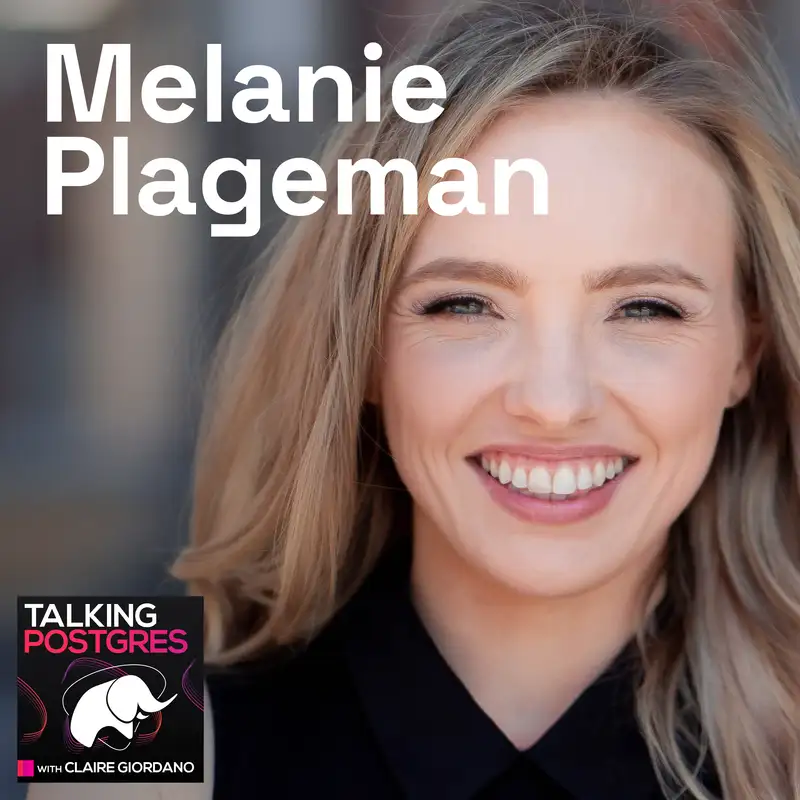
What Postgres developers can expect from PGConf.dev with Melanie Plageman
Download MP3CLAIRE: 00:00:05
Welcome to Talking Postgres, a monthly podcast for developers who love this database. I'm your host, Claire Giordano, and in this podcast, we explore the human side of Postgres and databases and open source, which means why do people who work with Postgres do what they do and how did they get there? I want to say thank you to the team at Microsoft for sponsoring today's conversation. And today's guest is Melanie Plageman. Melanie is a Postgres committer, Postgres code contributor, works at Microsoft. She's actually, I think, technically a major contributor. There's different levels of official recognition there. Anyway, Melanie works at Microsoft on the Postgres open source contributor team. She's an organizer of the PGConf.dev conference on the talk selection team for POSETTE: An Event for Postgres and probably several other conferences that I'm overlooking right now. And I am thrilled that Melanie is here again because she has been a past guest on this podcast about a little bit more than a year ago, talking about her process of becoming a Postgres committer. Welcome.
MELANIE: 00:01:17
Thanks, Claire. I'm happy that I could be here today and to talk about one of my favorite topics.
CLAIRE: 00:01:23
Well, and so with that, we should probably tell people what the favorite topic is. So we decided to focus on PGConf.dev and specifically, I think the episode title is going to be what Postgres developers can expect from PGConf.dev. Does that sound right to you?
MELANIE: 00:01:41
Yeah, totally. I can talk a little bit about PGConf.dev and what it is. Is that helpful?
CLAIRE: 00:01:48
That is totally cool. I think people who haven't been will want your perspective.
MELANIE: 00:01:54
Yeah, so it's timely because January 16th of next year is when the CFP closes. So this is sort of to give people an idea if you're not sure if you would want to go or be interested or get anything out of it, what it's about. So PGConf.dev has been in its current form going on for two years. But before that, there was a conference called PGCon. And Dan Langille organized it for years. I don't know how many years, but in Ottawa. Every year it was in Ottawa. And it was kind of like hackers got together and they, you know, talked about basically hacking Postgres and then also other community topics. But it was kind of like Dan organized it and there was pizza on Friday and it had that sort of informal hacker vibe, and I actually, that conference was really important to my development as a Postgres hacker because I had heard that it was awesome and that I should go and when I started hacking on Postgres like I was working at Greenplum and was interested in working more on upstream but didn't really know what I should work on or whether or not you know I didn't really have a direction yet and so I went And they used to, they have like a thing at the University of Ottawa where they rent out their dorms and you could pay like very little money. I don't remember what it was and have a shared room. You could have your own room too, but the cheapest is with someone you'd never met in a college dorm. So that was what I did the first year. And, you know, there's all these, you know, senior contributors that were there and you could talk to them and ask them questions. And, the first major feature that I worked on was an idea that Thomas Munro and Tomas Vondra were talking about this hash join feature and how to basically how to avoid this particular scenario. Or it was basically a bug that was tricky to fix and involved. The perfect solution was a big architectural change to hash join. And so I was like, okay, I'm going to do that. And it took me, I think, a year to even do the first version. I mean, not working on it continuously, but in my free time. And that was my first experience trying to write a major Postgres feature. And I never would have done it without having that in-person hallway track conversation. And I think PGCon was really like why, you know, one of the reasons why I'm a Postgres developer today. So when I heard from Jonathan [Katz] and other folks that they were thinking about transitioning the conference or that Dan was ready to focus on other things, I thought it's really important that this event continues because this is how we get new people. This is how they get inspired and motivated to actually stick around. So even though I did not want to do conference organizing at all, I agreed to try to help. And I'd never done it before. I think my closest brush with event organizing was organizing my wedding and I had a planner. So basically, I was completely out of my depth and had no idea what I was doing or what was required.
CLAIRE: 00:05:29
I've seen pictures from your wedding. I was not there, but you have showed me some pictures, and it looked pretty darn awesome. So anybody who's getting married in the California Bay Area and needs a wedding planner, you should contact Melanie and get a tip.
MELANIE: 00:05:42
Yeah, we got married in the Computer History Museum and had a hacking themed wedding and hackathon at the wedding, etc. So there was actually a surprising amount of overlap between that and the PGConf.dev event. So yeah, that's basically the background of how it came about. And it's still today, you know, a lot of the content is focused on Postgres development, but also extensions and the ecosystem and community building. We have all these people, wonderful people in the community that are making contributions other than code to the project. And they also need to get together and inspire each other and talk about what's not going well and come up with solutions for what They could do differently. And I think when, we, this new iteration of the event, one of our goals was to come up with different ways for people to interact, other than just relying on the people running into each other in the hallway and talking. So coming up with interactive content, you know, like workshops and panels and finding ways to take things that were happening, like the developer meeting, and democratizing access to it, creating these pathways and these sort of lanes for people who wouldn't necessarily just walk up to a senior contributor and start telling them their feature idea to actually interact with them. And then ways to create a sort of a corpus of material for teaching and, you know, I think introducing at least people to Postgres development and community organizing. And like, that's the reason why I still do it is that I think the opportunities to do the non-standard, not just a conference talk, right? Like getting to have these experimenting with these different types of content and having the goal just be like, let's get people to together and create environments where they can come up with new ideas and try new things and where we can get new people to, to want to stick around. That's a really interesting mandate. It's not a conference. It's a multimedia experience. So, yeah.
CLAIRE: 00:08:06
I love it. Okay, so let's back up for a second. And I want to just get some facts on the table as I see them. And then you tell me what I'm missing. So the PGCon conference that you talked about that used to be in Ottawa transformed or morphed into PGConf.dev is what it's now called. And you're currently planning the third year of PGConf.dev since that cutover or migration, if you will. The first year it was in Vancouver. Last year or earlier this year in 2025. It happens in May. It was in Montreal. And in 2026, it's going to be back in Vancouver. There are about, I don't know, 200-ish people there, although I'm assuming you're planning for growth in 2026. Correct me if I'm wrong.
MELANIE: 00:08:58
It's interesting we in after the first year we you know we sold out the conference and so we said okay, we're probably going to grow in the second year. And then we didn't, and the attendance didn't grow. So that's, that changes as a conference, you have to figure out which direction you're going. If you don't think you're going to grow attendance, either, you know, you can devote your time coming up with strategies to grow attendance, which I think has merit, right? Or you can say, okay, given our budget and the number of people we can expect to come, How can we make this experience as enriching as possible for those people? And we've kind of taken that strategy. So it's not that we don't want new people to come to it. It's just that there's only so much time. We're all volunteers. So we decided to focus less on, you know, we're still reaching out to people. We're going to post flyers on college campuses, but we're not planning for massive growth right now.
CLAIRE: 00:09:56
Okay. Well, and that's kind of why I was envisioning that it will grow, because I know that you're planning on reaching out to college professors and flyers on campus. And I imagine for a student who has taken maybe a grad student or someone who's taken a bunch of database classes, even as an undergrad, if they found out about this, if they knew about it, particularly if one of their professors nudged them to go, I think they would just get a lot out of it. I know that the senior contributors, right, the existing community members get a lot out of it. Like people absolutely love this conference as an attendee. But I also think that folks who are new would find it welcoming and would find that mix between introductory content and more advanced content. I think you have a spectrum of possibilities for people.
MELANIE: 00:10:49
Yeah, it's interesting because we do try to have beginner-friendly content. And I would say that it's just very hard to, so we've had it in the past. We had an intro to hacking workshop, an intro to how community development works, workshop. And you talk to people after and you say, you know, what did you get out of that? And what we at least saw in the year that we did that was we didn't get much conversions. Like, and we also didn't have people say we had one or two people say that was good. I enjoyed that. But it wasn't a resounding success. So we were like, okay, maybe people don't want an instructional workshop at this event. Maybe what they need is more opportunities to interact with people and get inspired. So not directly like instructional. So I would say that like, well, we do strive to have beginner friendly content. I think we're trying to find ways to interact with people that are new to the community that makes it most likely that they'll feel welcome and actually, you know, stick around. And maybe later, they, you know, engage with educational content and there's resources like Andrey Borodin's, I don't know if he's still doing the YouTube series, but where people review patches live and there's Robert's hacking workshop thing. And what we've found so far is that pure educational initiatives or extremely beginner friendly content isn't always very popular at the event. So that's one thing that we're trying. And we would love more feedback about this. And a lot of times beginners will say, well, I want to go to the really advanced stuff because I want to be like, you know, drinking from a fire hose. That's what I want out of this conference. So we're trying to figure out the right balance.
CLAIRE: 00:12:42
At the end of the day, people are all different. So if you find the right balance for someone, then it's, it's, you know, you're, it's hard. It's, you can't meet everybody's needs, I suppose. But it sounds like you're trying to meet as many people's as possible within this developer community.
MELANIE: 00:12:58
And for conferences, you deal with a pretty limited amount of feedback. Like we were really lucky because you did that unconference session where we got a lot of feedback. That was great. We did have a lot of people fill out the survey. For an individual piece of content, you're usually relying on only a couple pieces of feedback, right? So we've been pivoting hard every time we got feedback that was like, maybe you should do something else. And maybe that's not enough. Maybe you need to do it for multiple years to see the results. I'm not really sure. I think my tendency as soon as I get feedback is to try something totally different, right? And maybe that's not the right strategy. I don't know.
CLAIRE: 00:13:38
So let's talk about the structure of the conference really quickly, because you just mentioned the unconference. But before we dive into that, Tuesday is usually some kind of pre-conference day. In the past, maybe there have been that's when the developer meeting happened last year. That's when the community summit happened, the extension summit happened. And I know Tuesday is going to be different this year. And we should talk about that in a little bit, too. Wednesday and Thursday have historically been the more traditional conference days with a keynote speaker and a bunch of other speakers and sessions. But you also had a community booth and you experimented with things that were, you know, more interactive types of things, where people could sign up to have someone, I don't know, help them. Well, you can explain that to us in a minute. And then Friday is the unconference day. And that's super cool. And every as far as I can tell, everybody stays for the unconference day, even though you don't know what the schedule is until you make it that morning, right? So it's kind of it can be a three day event for people who skip the Tuesday or for many people, it's a four day event. Is that a good overview?
MELANIE: 00:14:54
Yeah, I would say this year, Tuesday is a full. So previously you had to pre-register for Tuesday's events. And basically, if you didn't register, you couldn't wait enough food. We didn't, you know, we weren't, it was a smaller day in terms of number of people. But what we decided to do this year is it's completely, it's open to anyone. Anyone can come. You don't need to sign up for anything in advance. And all of the, we're going to have enough content and enough stuff going on that everyone can find something. So it's a full day of the conference. The format will be different than the longer summits that we did last year. Instead, we're splitting it up into one hour or up to two hours, depending on it, like what we're calling community discussion sessions. And so it's kind of a day to take specific issues that you have, you know, whether it's something you want to change about the development process or you want to talk about, you know, the tools we're using or you want to talk about how the contributors recognition process can be different. Like some sort of issue that you want to meet with people and talk about that. Or it can be something, you know, within the ecosystem, like changes to the protocol and things like that. And so you suggest a session through the regular CFP. And then what you can sort of say, OK, this is there are certain people that we need at this meeting for it to be productive. Right. Like if, you know, Chris Ellis and Boriss don't agree to come to this meeting, we might as well not have it. And that's basically just to say, you know, sometimes what you find in these small group breakouts is that, oh, hey, we don't have anyone here who actually works on this. So there's no point in having this meeting, right? So in the community discussion sessions, you specify who would have to be at the meeting to make it productive. And then the rough, like, size that you think would make sense to allow into the meeting. So if you say, okay, if more than 30 people are in the session, it's gonna be too difficult to have a discussion, right? So then we'll put them in small rooms and anyone can attend unless you mark it as private, which is the security team might need to do that and have a private meeting, right? And so people that are attending Tuesday can wander into a session. Maybe they don't know anything about the Postgres protocol or they don't know anything about you know, how, what Psycopg and JDBC need from core, like, but they can learn about it and hear people who are working on those topics directly talk about it. And in that way, it has some similarities to the unconference, but it's all proposed ahead of time and people prepare material, that kind of thing. So it's a way to democratize content like the developer meeting, which was historically on Tuesday at PGConf.dev and make it so that also that people can go to more topics so that they can, you know, if they're interested in a particular topic, they can go to be part of that topic discussion and then switch. So you're not dedicated to a three-hour meeting where you only care about one topic. So it's a combination of wanting to democratize access and also free up people's time to be in more concurrent sessions. So all of that is happening. And then we also have another thing that's happening, which is, let's say 100 people at the conference are like, I don't want to go to a meeting about any of these topics. Well, we're going to do what we call the large room track with entertainment kind of content that's more focused on panels. Basically, it'll be almost all panels. And these are going to be things like, we still have to go through the CFP process, but imagine getting to pitch your Postgres feature idea to a group of committers or having senior contributors talk about the biggest mistakes they've made or whatever. We're going to have panels that highlight or imagine hearing conference organizers talk about how you can get involved. So have content that spotlights community members and things that they're doing, efforts they're doing in the community, and that's accessible to anyone. So it's sort of that beginner-friendly thing, but then it also might be interesting to experienced people.
CLAIRE: 00:19:23
When I look at the CFP page, which I either just shared or I'm about to share in the Discord, and we'll be sure to put it in the show notes when we publish this episode, it looks like there are for the community discussion sessions. So there's CFP info all about talks you can submit, right? And then for community discussion sessions, there's the open discussion sessions. That's what you just talked about a few minutes ago, right? where you have required attendees and then anybody else can be in the audience and kind of be a fly on the wall right um and then I see the closed sessions you talked about that example the security group um working groups did you cover that one?
MELANIE: 00:20:06
So that one is basically that you would you would have that it would be limited to a certain number of attendees above the ones that you mentioned. So the idea there is that maybe it's kind of like that invite only structure that the developer meeting had. If there's something where you feel like it would be productive to have the discussion be limited, because the people that you specifically specify are going to be the people presenting or talking or having discussion, right. But if you think that there needs to be other, it's halfway in between open and closed, if that makes sense.
CLAIRE: 00:20:48
Okay, got it. And then there's this more, I don't know if entertainment's the right word, because then when you said that, I imagine people getting up there with their guitars or, you know what I mean, music, but the panel discussions that people can learn from and that'll be inspiring. And that's a fourth category, if you will.
MELANIE: 00:21:08
Yes. Oh, and the other thing about working groups and open discussion. So an open discussion will be more like an unconference session where people can raise their hands and ask questions and weigh in, even if they're not one of the people that's sort of prepared for the meeting ahead of time and is a key attendee the working group will be basically if you attend and you're not one of the key people like it's more like your fly on the wall kind of thing and the open discussion is a bit more like the unconference and then you're right entertainment is probably not the right word but I think we realized with these community discussion sessions that it there would be people who were especially maybe if you're just getting started out in the Postgres community, maybe taking a step back and not being expected to participate in something, right. That can be intimidating to jump into a meeting of experienced Postgres community organizers and a small group setting, right. And if each if we have 200 people and we have three concurrent sessions, you don't want, you know, like 60 people in a meeting. So this is sort of the idea is like once the rooms are at capacity, then everybody else can go and have another way of connecting with the community.
CLAIRE: 00:22:29
So when I think about the target audience for PGConf.dev, I see three classes of people. And tell me if I'm wrong, because you know this way better than I do. I mean, obviously, the first class of people are existing Postgres contributors, committers. They can be code contributors or they can be other kinds of contributors like me. So that's that's one class. Another class are people who are perhaps new to Postgres, new to Postgres as a contributor, as a developer, as a user. And they're just there to figure out, like, do they have a future? Do they want a future working on this project? The third class of people are and I have seen Postgres users who attend, right. They're not contributors today. And maybe they don't want to be beyond filing of bugs, right. But they still there's a lot of value to be had by attending sessions and learning about different aspects of particularly the new releases and some of the new features. Those are the three buckets. Did I miss anything?
MELANIE: 00:23:43
I think there's one, I don't know if this falls in, but like, you know, maintainers of ecosystem projects. So drivers and extensions, they have things that they need to talk about in a group. And there isn't really another event that caters to that. And then they also have things that they would like to talk about with core developers. And so I think that's sort of another category. And with the users, like you were saying, I think there are also advanced users who are like, this is a persistent problem that I'm having. It's not a specific bug, but Postgres architecture or something, you know, sort of in Postgres needs to change because these are the modern use cases. These are things that we're seeing, you know, in the field, basically. And if it's not a bug, we might not hear about it, right? So seeing those patterns, hearing from advanced users about how they're using Postgres is really important.
CLAIRE: 00:24:42
Which brings up this word that if you haven't attended Postgres conferences or other tech conferences before, maybe you're not familiar with the term hallway track. But the hallway track at PGConf.dev is incredibly vibrant and energetic. And I at least feel like I could walk up to anybody, introduce myself, talk to them. And so, yeah, there is that ability for a user to go introduce themselves to somebody who is a committer, is a contributor and might have an opinion or some ability to influence the future of Postgres.
MELANIE: 00:25:21
Not everyone feels comfortable doing that so another thing that's one of our core goals is to kind of create opportunities to break apart cliques of people that already know each other and infuse other people into it, so we're doing a um like a novice or you know new to Postgres breakfast where people that either haven't been to a conference before or are new to using Postgres or maybe there's new to Postgres conferences will come and then experienced community people will be there in a small group setting where they can all talk. We're doing last year we did something or this year we did something called the meet and eat where you sign up and one of the nights you get put in a small group and we specifically tried to mix together experienced and new people into groups and you go out to eat to dinner with those people.
CLAIRE: 00:26:13
And can we pause on that for a second, what was really cool about that is once you sign up then you get assigned to a group of people and the group of people like mine was like eight or nine right so mine wasn't a crazy big group um but it was big enough that there were there were definitely interesting people to talk to and what I like about it is you don't have to figure out how do I get invited to one of these dinners or you don't have to find the right person who would invite you, you know. It's the structure is there and it's provided by the organizers by you guys and uh it was really nice. I liked it.
MELANIE: 00:26:53
Also usually at a conference when you're all standing around trying to figure out where you're going to go to dinner you have a group of 20 people that suddenly are like we need to go somewhere and we don't have a reservation so I was like maybe we can solve both these problems which is actually being able to go somewhere and get enough seats and everyone eat and you know getting some mixing so we're going to do it on two nights this year instead of one um because there's the night that traditionally like if your company has enough people there and they're doing a dinner that means all the people that are not doing that are sort of left to their own devices. So we're going to do a second meet and eat for for that night as well so we're like really trying to fill in the spaces. Obviously you still want time for people that are going there to like, I go and there are people that I work with only online that I only see once a year at this event right so I obviously want time to talk to them, catch up on like, you know, how's your new house? Like, what are you up to? And, you know, sort of have like private one-on-one conversations with them and talk about ideas and what we're working on. But like, I think we can allow those spaces while also trying to fill in as much space as we can with getting people together and pushing them out of their comfort zone, right? Like, I think a lot of this event is pushing people who are used to going to these events and hanging out with the same people out of their comfort zone. But like you get something for it, right? You get to go to a restaurant with a reservation. So like even if you would rather maybe hang out with the two people that you are, it's obviously optional. But that's sort of like we're trying to create value by giving people new experiences and that benefits people who already know people as well as new people.
CLAIRE: 00:28:36
Well, and the timing of PGConf.dev in May, I guess I can't read Dan Langille's mind to know why May was selected way back in the day, many, many years ago when it was PGCon. But the timing is pretty perfect for kicking off the development cycle for the next release of Postgres. So by the time you get there in May, PG 19 code freeze will have already happened, right? And because that happens in the beginning of April. And so it'll be time to start working on, oh my gosh, Postgres 20. Is that right?
MELANIE: 00:29:13
Yeah, yeah, yeah, yeah. No, it's a really important time of year for reconnecting and coming up with ideas for the next release, right? So one thing that happens at other developer meetings, like the FOSDEM developer meeting, they spend time looking at, okay, what patches are still out there that like, we need to figure out if they're going to go in or not go in or whatever. It's more tactical and specific. But at PGConf.dev, like, it's that breath between releases, obviously, we're still stabilizing the, you know, we'll still be stabilizing 19. But we like, there's all the crazy ideas can come out, right? We can be like, what if we did multi threading, or, you know, and that, that kind of stuff maybe it starts on the list but like momentum and that at the um PGConf.dev this year like the multi-threading people were like we should actually make a working group and and commit to action items you know that kind of thing um and so it's kind of like uh it's easy if you said you were going to do something but you never see the people asynchronously to kind of just ignore that thread on hackers but if you see everybody in person it kind of is like oh yeah that is to me, I do want to make sure and do that and coming up with ideas. And so in the development calendar, it's at a particularly also like, what features slipped the release, and it made me sad, like, it's just this time that it's kind of like any, it's almost like a launch party, I want to say, like, even though it's not really launching, because we don't have anything like that in the community, right? We don't do parties when a new release of Postgres comes out. So it's kind of like that time where you do the things you might do in a traditional like project that that to celebrate to mourn you know to to get together and figure out what's next and I think it works for non-code contributions too like you know what do we want to do differently in the next development year also works for non-code contributions.
CLAIRE: 00:31:18
I worked the hallway track last year looking for future podcast guests, right? Getting people's ideas about what episodes really resonated with them and who else do they want to hear from. And I got a whole bunch of good ideas from people who were there. I have this quote in front of me that's actually from you, Melanie. And it was from the trip report that I wrote internally at Microsoft after going to PGConf.dev last year. And it wasn't just my trip report. I was trying to represent like our whole team of open source contributors for Postgres. And I just want to read it out loud. I hope it's not too long. Those of you on the Discord chat, let me know if it was worth it or not. But you told me, PGConf.dev is at the end of the development year and an opportunity for us to reconvene, reflect on our missteps and feel less alone when sharing those missteps and get excited about what we're going to work on in the next year. It's a chance to find out how everyone is doing and to connect on a human level, to find people who are interested in the projects we want to work on in the next year and convince other people who are planning to get in the way of those projects to reconsider. It's a giant mix of negotiating, celebrating, planning, mourning, educating, and inspiring. You said that.
MELANIE: 00:32:38
Yeah, well, that sounds better than my rambling just now.
CLAIRE: 00:32:43
They're both good. They're both good. I just like that mix of negotiating and celebration and planning and mourning. I mean, there are all those dichotomies and different sides of different coins that are happening together.
MELANIE: 00:32:57
And we don't have another venue for that, right? Like when else would we all do that? You can't really do that stuff remotely. Like how would you, you know, do that? It wouldn't, I mean, some of it may be tactical specific stuff, but it's an emotional thing, right?
CLAIRE: 00:33:13
So on the chat, Boriss Mejías asked a few minutes ago if you could help him understand the difference between, say, PGConf New York City, which is a very, I think, user-centric conference, although it has a lot of committers and contributors who were there as well and who are speakers typically. PGConf New York City versus PGConf.dev. People understand.
MELANIE: 00:33:38
Yeah. I think Tristan's answer is good. And basically, yeah, every other Postgres conference is more user-focused. But I think there's actually a distinction that I like even more because there might be content from users at our conference. It's that other conferences are more outward-facing. I know, PGConf.EU did do a community day. But this conference is about the people making Postgres and the Postgres community. So everyone is welcome but they're welcome with the idea that like you're gonna do work right you're not there to uh you're there in your I guess you're there in the role of like contributing to the community so if you contribute by just talking about how you use Postgres that's okay too but the whole point of it is it's it's like for the community internally to try to make ourselves better it's like a community development sort of like if you have a retreat for work or whatever, where you're like, let's all connect more. Let's figure out what's next. It's that. It's not to try to convince more people to use Postgres. It's to try to figure out how we can make Postgres better.
CLAIRE: 00:34:51
So nobody's selling Postgres at this conference. And oh, there are no booths. So people sponsor. Microsoft is going to be a sponsor this year. Some of the other hyperscalers and Postgres companies are too, of course, because we know that this collaboration that happens at this event has to be funded somehow, right? So companies step up. But companies don't get a direct transactional benefit from the sponsorship at this conference. There are no booths. There are no scans. There are no, there's no sign that we get to put up, as far as I know, that, you know, advertises our Postgres, you know, database services. But the benefit we get is, of course, the fact that it contributes to the health and the future of this community of people who work on the project. And anybody who's in the business of Postgres, and there are a lot of companies, I mean, I think Postgres is a it's a multibillion dollar industry. And anyone who's in that business knows that you've got to support the upstream project. You have to fertilize it, nurture it, grow it, invest in it. And that's part of what sponsoring PGConf.dev gets you.
MELANIE: 00:36:08
Yeah, and I I tell people it's like would your office cancel the yearly project planning meeting where you decide your roadmap like it's not that simple because there's no roadmap right it's an open source project and we we do you know that's what's great about it. It's chaotic and it's it's not some, it's not top down, but on some level, we don't have any other project planning meeting, right? Like we don't have any other discussion where we're all in person. There's nothing. So like, why would you as a company that relies on Postgres not sponsor the event? That's the closest thing to that happening, you know? So, yeah.
CLAIRE: 00:36:48
Yeah. So if you're listening and you don't know if your company, your business, your project is a sponsor yet, you should go. I'll make sure in the show notes to include the sponsorship link. And so you could you could look into that. And of course, there's different levels. And I'm not meaning this to be a sales pitch. I'm I first of all, I'm not part of the organizing team for PGConf.dev. I'm not on the talk selection team. I will volunteer as we get closer and I like to take pictures of speakers. So that's probably the way in which I'll volunteer. Oh, you're hiring a photographer this year for one of the days, though.
MELANIE: 00:37:24
Yes. Okay. Wait, before we keep going, because I know some people might drop at two, I wanted to answer Boriss's question about, or two things that he said on the chat. So one of them was he mentioned the debates they did at PG Day Lowlands. And I did, so I talked to Derk about this because I thought that was a really interesting format.
CLAIRE: 00:37:33
Okay, Derk van Veen.
MELANIE: 00:37:44
Yeah, and we discussed like if so he can't come to PGConf.dev, he said, but because we're in the CFP process right now. So anything like that debate idea would have to go through the normal CFP. That's kind of how we're trying to make it fair, even for content that we're kind of soliciting. And so if someone from PG Day Lowlands or someone else, but preferably because they actually have experience having done it and know what worked and didn't work, wants to propose that, we would be interested in doing the debate. Because I think it's a really interesting, you know, idea, which is like you have instead of a panel, you have kind of like your high school debate team take for and against a particular idea positions, and then you have to like argue for them. So things that we're very interested in and we would love to see proposals. Like we also have a category, which is other ideas, right? So do you have an other idea? Like last year, one of our most, or this year, sorry, 2025, the new thing that we did that was very popular was poster sessions. So Andrey Borodin organized this. He is an academic and like said, you know, in academia, we have these posters and we put them up and then people can like look at what projects people are working on and it doesn't have to be a whole talk session and people loved them and we are uh we're good we're doing it again but we're making it even bigger so even if you don't attend the conference you you know if you can't make it you can have a poster for your project or your initiative or whatever um we'll print them out we're going to feature them and we're going to have time where people can go and talk to the poster uh like owner, they'll stand by their poster if they're there and you could ask them questions and so that's something that we've got great feedback about and we're like okay let's blow this up and make it bigger and a bigger part of the event.
CLAIRE: 00:39:34
Is there going to be a separate call for posters or what's the timing on that?
MELANIE: 00:39:41
Yes, yes. That'll happen after the main CFP closes and they all go on the website too so last year's all the pictures of all the posters are on the 2025 website and the 2026 will go on the website too and so it's a great way if going to be there and you want to you know talk about something you're doing or like it's also for if you have a patch and no one's paying attention to it or like it's kind of this um you know this way to get people engaged with their content um so that's a new thing that we're doing and uh there's like other things like we do a run um like a you know Yurii [Rashkovskii] organizes a run where he plans a route and and you can walk or whatever pace you run and go on that and like any new ideas for different types of content and like ways to engage we're looking for that so you can submit anything that's just like an other ideas category so you could submit it to there.
CLAIRE: 00:40:34
I love it.
MELANIE: 00:40:36
And the other thing that was asked was about anniversary celebrations of Postgres so um [Drum roll, drum roll, drum roll.] yeah so 30 years of the open source project, 40 years of the Postgres like code base or you know [Technology.] yeah technology uh so there may be some other community anniversary celebration like I know there are people that are talking about it working on it whatever but that we are definitely going to do things to celebrate it at this event so for example um we are this is still in development like but we're trying to or and we're not having a traditional keynote or we're planning on having some of the original people that were involved in the open source project talk and that's where we're still, I think we're still ironing out the details but I think like it to honor the anniversary we want to make sure that there is a spotlight on some of the people in the community that were there at the very beginning so that's why I was saying like you mentioned the photographer, I want to have someone come and take high quality pictures of all of the, you know, the people that have been in the community for a long time and everybody that's new, right? Like we have this amazing journey. Tomas Vondra is going to put together a massive slideshow of pictures from the past 30 years all the way up until today. Like last week, the Nairobi PUG, the new Nairobi PUG had its first meeting. Like we have this huge journey with this giant global community. So if you have photos that you want to share and have in the slideshow, send them to Tomas Vondra. We're going to project it either on the wall or have it on a screen. We're also working on special stuff like special swag for the anniversary and then other opportunities to sort of commemorate and engage with it. So it's a lot of TBD, but we're definitely going to be highlighting it.
CLAIRE: 00:42:33
One of the things that I think is really important for the Postgres community, and I know that the committers and the core team and the major contributors are all probably talking about this, thinking about this, like planning for the future, not in a roadmap sort of way, but in a, hey, over time, eventually some people are going to move on or retire. And so I love the fact that everything you're talking about for PGConf.dev, yes, it will help Postgres 20, right? It will help the next release. It will help the existing contributors and committers. But I love the fact that you're also looking at how can you like democratize access and make all this information available, accessible, inspiring to what will effectively become the next generation of open source contributors. And I think that's important. And you know that because I like that's one of the goals for this podcast, right? It's unstated. You don't find it when you go to talkingpostgres.com and you look at the episodes. It doesn't say that our goal is to nurture the next generation of open source contributors and committers, but that is one of the unstated goals. Like, I want this to be interesting to you, Melanie, and to other, you know, Postgres contributors and users, but also to people who are just getting involved, to give them that peek behind the curtains, if you will.
MELANIE: 00:44:02
And there's, I think there's a lot of people that are, you know, in the ecosystem, they're working on a project that is related to Postgres. And we haven't, like, quite sucked them into the main Postgres community and got them involved in event organizing. And there's all these app developers, right, that are using Postgres. And, like, they also could have a voice and add value to the direction of Postgres. So like when talking about expanding, I think, you know, the event, we do want even more perspectives. Right. So one thing that we're like, as we're talking about the CFP, if you're like, well, I'm not a Postgres developer and not a conference organizer. Like, could I submit a talk? You totally can. So like I mentioned that we want the perspective of so you just think of it from the perspective of like, I'm a user. So here are things that I wish would be different about Postgres. So as you're thinking about your talk proposal, thinking about how to frame it so that it's about making Postgres or making Postgres community. There are people that have, you know, submitted talks about like, I think this process should exist in the community for recognizing contributors, or I think we should have a foundation or I think, you know, whatever, like the angle of your talk is like this is what post the Postgres project like needs to be or this is my idea for what I think it should how it should be or how it should be different or how it could be better right and um those perspectives are really important like I think Chris just mentioned that not you know app devs don't always feel comfortable submitting um but like if the conference was just feature ideas in a vacuum and it's you know Thomas Munro talking and Heikki talking about multi-threading and then uh you know me and Andres or whoever talking about obscure performance issues like then it's not it it becomes insular right like if we don't if we're not like other conferences have user concerns in them but if we're not also hearing about what users need to change in Postgres, then we won't actually do it. Not everyone is reading pgsql-hackers or going to send an idea to the mailing list that doesn't come with the patch because that's often discouraged. So I think it is a venue for that. And if we don't have that, then it has less value because how are developers going to know what to make?
CLAIRE: 00:46:40
What's interesting is this notion of imposter syndrome to me it's something that so many people feel a lot of people don't say it out loud a lot of people don't admit to it but it's just so easy to feel that way and to hear Chris talk about you know not feeling quite comfortable pitching a talk for a PGConf.dev. Chris is brilliant. He has so much insight to share about how he uses Postgres and what he needs and stories to tell about failures and successes and requirements. And like, if Chris can't submit a talk proposal, I don't know. It's just, it boggles my mind sometimes.
MELANIE: 00:47:20
Yeah I definitely want to know what we can do to make it feel accessible like I like I don't want like I think some group like there are some let me think okay Linux Plumbers conference is an example of another conference that is sort of has this it's content about making Linux right and I haven't been but like because I think it's invite only but my understanding of it is it's like, it's very, you know, like it would be very intimidating for a Linux user to go even if it was open right but like we want to have some of the aspects of what happens at conferences like that, which is productive forward work towards like features and solving systemic like developer quality of life stuff, right? For us as Postgres hackers. But that is only half the picture, right? I would be really sad if our event was something that, like I just said, doesn't have the perspective of Postgres community organizers and, you know, app developers and users. And like, because we would be missing that. This conference has these two purposes. I mean, I guess three, if you consider growing new people, like one of its purposes is to figure out how to move forward on new work in the database. But another is to figure out what should we be working on? And you don't get that without other perspectives.
CLAIRE: 00:48:54
Letting that sink in for people, hence the blank space. Okay, so if you're listening and you want to attend and you work, like some people work for a boss or for a company where they just tell their boss, I want to attend and it's all paid for and no business justification needed. That's cool. But some people need to write up a paragraph of business justification in order to get their bosses support to attend and to travel. And maybe they have to get a visa and fill out some forms and things like that. So for me, what I wrote up last year in this trip report that I mentioned a few minutes ago, as I wrote, it's where the next release begins. It's where decisions get made for the project. It's where the next generation of contributors is nurtured. it's where our Postgres contributors refuel and reconnect. And I just wrote down those four points, but you're mentioning even more points than that. So...
MELANIE: 00:49:54
And we also have a travel grant this year so um there's an application um if you go to attend on the website and then click travel grant it describes it and has an application but uh it for people that are like you sort of have to have the intent to contribute to Postgres or be contributing like one of those things uh to be eligible for it but the idea is like not everyone's employer is going to pay for them to go. So it covers hotel and the conference ticket. And then in some cases we can cover flights, but it's the idea is that like, we want it to be accessible. I think also, I don't know if people notice, but the price of the conference is much lower than last year. So our 2026 will be 350 Canadian and it used to be 500 Canadian. So we are, As soon as we got sponsorship dollars, we were like, what can we do to make the conference accessible? How can we make it so that more people can come to the event? So we have the travel grant, the ticket prices, we've lowered the ticket prices. So we're really trying to make it something that more people can attend.
CLAIRE: 00:51:09
The location is Simon Fraser University, which I guess the acronym is SFU. Is that right? And it's it's right in Vancouver. So there's a ton of nearby hotels. I mean, I know some people prefer Airbnbs, but for me, I stay at Marriott. So there's a whole bunch of Marriotts in the area, walking distance even from this. Lots of coffee shops nearby.
MELANIE: 00:51:31
And one of the things is Vancouver is more expensive for hotels, you know, it's not cheap. So I think in our hotel blocks, like having the travel grant for that should take away one of the big barriers to attendance, we think. um so it's much easier to get like if you are an accepted speaker then the travel grant is like i won't say it's guaranteed but like it's much more likely if your employer can't pay for you um if you're not an accepted speaker you can still make a case for like what you are going to what you are or are going to bring to the Postgres community and how you're going to contribute. Yeah, you should, you should do that.
CLAIRE: 00:52:10
Obviously if your employer can pay for you to go that's the way to do it, well because that way you have the funds available for people who really really need it [Yes.] and for people who are going to have to say no or not not attend um so yeah so I know there's so much more to talk about with PGConf.dev, but I also want to ask you about other talk selection teams that you might be serving on. Are there any?
MELANIE: 00:52:39
Yeah. Yeah. Claire, who has made the POSETTE CFP deadline the same as PGConf.dev.
CLAIRE: 00:52:55
No, I haven't. [No, isn't it January 16th?] No, no. The POSETTE, February 1st, Sunday, February 1st, which is the Sunday of FOSDEM. [Oh.] So at FOSDEM, I'll be able to work the hallways or work the college campus in Brussels, making sure people remember and don't miss the deadline.
MELANIE: 00:53:08
Oh, you're right. Okay. I just checked. Okay.
CLAIRE: 00:53:10
Yeah, I wouldn't do that to you. I don't want to compete with PGConf.dev at all. And of course, because that's totally different, right? No, it's a virtual event happening for the fifth year. And anyway, Melanie is serving on this talk selection team. And I know it's a lot of work because last year I think we had 240 talk proposals. So it's a lot to review all these proposals. I feel like your, obviously your PGConf.dev work is even bigger and even more than that in the sense that you are both an organizer and on the talk selection team for PGConf.dev, right?
MELANIE: 00:53:49
It's a lot of work.
CLAIRE: 00:53:51
That's a ton of work, which is high impact. I know at Microsoft, all of our rewards and promotions and things are all tied up with this concept of impact and, you know, finding ways to shine a light on what, how have you changed? Have you changed things for customers, for users, for the community, for your teammates, right? In a positive way. And I feel like what you're doing for PGConf.dev is definitely high impact. Anybody else who agrees with me on that should be sure to tell Melanie's boss. But has that an event for Postgres virtual February 1st is the deadline. And I really appreciate your help sifting through all of those proposals and finding, OK, what are the right set of 40 virtual talks that we should record and publish?
MELANIE: 00:54:44
POSETTE has a higher volume of submissions to review usually, but for dev I also rewatch every single talk from the previous year, or I did last year and this year, and watch talks from every single submitter if I haven't seen them speak before. So it takes a really long time to review those.
CLAIRE: 00:55:04
Well one of the things that I learned about you in one of the previous podcast episodes where you joined Talking Postgres is you told me about, you're a runner, and you told me about how you will often listen to conference talks that are published on YouTube or whatever. Hopefully you're not looking at the YouTube video while you're running, but you'll be out there on the streets of Pennsylvania listening to these conference talks as a way to like get your exercise done and learn something new.
MELANIE: 00:55:35
That is how I manage to watch them all, just to be clear. I don't sit and watch all of them in a row while doing, you know, I do it while running, which means that I've gotten very good at trying to understand what people say without any visuals.
CLAIRE: 00:55:50
Yeah and without the captions, right? I always turn captions on when I'm watching um I'm watching anything whether I'm watching a technical video on YouTube or watching Netflix on my TV. So yeah, you don't get captions when you do that. But what's cool about the fact that PGConf.dev records the talks is that, and not all conferences do that, but I think it makes the business justification even stronger for a speaker. Because it's not just that they're going to reach the people in the room, but they have the potential to reach many, many more people online digitally.
MELANIE: 00:56:28
Yeah, and so in Robert's hacking workshops, about 80% of the talks, I would say, come from dev.
CLAIRE: 00:56:35
When you say dev, you mean PGConf.dev?
MELANIE: 00:56:37
Yeah, from PGConf.dev. [Okay.] Just because it has a lot of, like, hacking-related talks compared to other conferences. And they record. So that's one way that the content is getting used in the community for other sort of like educational and collaboration focus events.
CLAIRE: 00:56:58
Okay, so context for people who are listening, Robert is Robert Haas, he's a Postgres major contributor and committer, long time person involved with the project and about a year and a half ago he started this new Postgres mentoring program and created a Postgres hacking Discord to kind of be the platform for it. And it actually came out of an unconference session at PGConf.dev that was in Vancouver that that year, 2024. And so they have these in addition to like having cohorts of mentors and mentees who he matches together, they have these monthly hacking workshops where everybody agrees to watch a talk that's been published online. And then you get together and talk about it and answer questions, drill down, debate, whatever. And you have to you sign up for these hacking workshops and you have to attend. He keeps track of who signs up and doesn't show up. So I think there's very few no shows. And he does it in a couple of different time zones so that somebody from APAC and somebody from America, you know what I mean? It can work out regardless of what part of the world you live in. And I don't know, Melanie, maybe you can share your perspective on this whole mentorship program and the hacker workshop. But I think it's a really cool testament to PGConf.dev that this thing even exists in part because of the unconference at PGConf.dev.
MELANIE: 00:58:31
Yeah, I'm always very excited when we have initiatives that people do that some of the conversation started there, projects or features.
CLAIRE: 00:58:40
That's really cool. And I have had Robert Haas on the this podcast, Talking Postgres, which is how I knew everything that I shared. I've only attended, I think, one of the hacking workshops. So I don't have a ton of context on like exactly what they're like because I only went to one. But I will share a link to the Robert Haas episode because for anybody who's ever thought about the challenges of mentorship and how to create structure around it, it should be useful to listen to that one.
MELANIE: 00:59:14
And coming back to the CFP, so what I've told people, and I will keep doing this, if you want me to review your submission and give you feedback, if you submit now, like, you know, within the next couple of weeks, so before the deadline, and ask me to do it specifically, like I will probably do it. I haven't gotten very many requests, so I've been able to manage it. But like, I'm happy to give you feedback if you want to know how could I make this more relevant to the audience or whatever. But like, you know, if it's the day before, I probably won't do it.
CLAIRE: 00:59:51
Well because you're going to have too many people asking you in the the days right before because so many people are deadline driven that is a really generous offer um and I think that if for some reason you find it too intimidating to reach out to Melanie for feedback on your CFP submission, first of all, she's awesome. And I guess I would say don't feel intimidated, but people can't help their feelings. But the other thing I would say is just do get somebody you trust to review your talk submissions before they go in.
MELANIE: 01:00:33
You can't feel intimidated by me if you've seen me do Spice Girls karaoke. So yes thank you thanks to Boriss for encouraging me to do more karaoke in public.
CLAIRE: 01:00:37
Which I understand you did. at PGConf.EU a couple months ago in Latvia, right? So there's another question from Boriss on the chat asking, you had mentioned earlier that when you are coding, you like to get in the zone, if you will, and you don't check messages or notifications at all, which is great. What else do you do to get into the zone? Music, headset, tea, coffee, water?
MELANIE: 01:01:14
I have a white noise, I have a white noise machine that I will use if I think that I'm going to be interrupted but um basically I just I prefer as much quiet as possible and if I'm thinking and not actually coding I like to curl up into a ball on the ground so I'd like the opposite of people that say they do their best thinking while walking or whatever I'm like stillness and silence
CLAIRE: 01:01:42
That's amazing. I've never heard that before from anybody.
MELANIE: 01:01:46
It's a weird thing that I've now shared publicly in a podcast, so.
CLAIRE: 01:01:50
Yeah, so I'm so the opposite of that I do my best thinking in the shower, you know walking, typing, like writing, scribbling, doodling. I have to, my hands, I guess, need to be busy or my legs. Right. But you curl up in a ball.
MELANIE: 01:02:09
Yeah, I guess it's like the fetal position. Maybe it...
CLAIRE: 01:02:12
Okay. Wait, don't you have cats? Do you have cats?
MELANIE: 01:02:15
I do have a cat. Yeah.
CLAIRE: 01:02:17
Is the cat curled up with you? Are you actually petting the cat?
MELANIE: 01:02:21
No, she's not allowed in the room when I have to think carefully because she's very distracting.
CLAIRE: 01:02:26
Oh, that's, that's good to know. Okay. So no pets is part of the equation for deep thinking too. Okay.
MELANIE: 01:02:40
So yeah, yeah. It kind of works out that I work from home because I definitely couldn't do the curling up in a ball on the floor thing in an office.
CLAIRE: 01:02:43
I think people might start to get worried about you.
MELANIE: 01:02:46
Yeah, I agree.
CLAIRE: 01:02:49
So there's something else that I'm curious about. If somebody is listening to this podcast episode and they get really inspired about what you're trying to do with PGConf.dev, serving the different needs of different people in the audience, right? Whether existing or future community members and contributors or users, and they want to help. Is that, I mean, I'm pitching you a softball here, but take it.
MELANIE: 01:03:13
Yes. We really love volunteers. So there's a lot to do when it gets closer to the event. There's some things to do now. But we definitely, like, we had a few people sign up to volunteer, and we've found tasks for them, and then we have more tasks. So there's things like helping us find a speaker gift that is, like, a local Vancouver thing, right? There's a list of things like that. And we always need help with, like, design things. It's pretty hard to get design volunteers. But, like, there are lots of things that go into the conference, and we need help with all of them. And if you aren't free in advance, then on-site we need tons of volunteers for being room hosts. And then things, like, set up and tear down. just like any other conference, but we also have sort of unique opportunities. Like we have the novice breakfast, or we're probably not going to call it that, but the new to Postgres breakfast, like we'll need experienced community people to meet and greet and network and interact. And that one's, I think we're going to probably get a good number of students at that. Right. So if you like talking to students about Postgres or whatever, we need people to do that. We need people to, you know, volunteer to help with like organizing the panels and we like to, you know, to onsite. We need people to help with the slideshow. We need people to volunteer to, with the meet and eat groups, like finding restaurants for them to, to actually be at. And a lot of this helps if you kind of know Vancouver, but you could do it remotely, you could look at Yelp or whatever. So there's tons of tons of stuff. We need someone to we have the T-shirt design almost finalized, but we need to order it and do the size breakdown, like all of that kind of stuff. So there's normal conference stuff. And then there's stuff that's kind of specific, like to the interactive content. Like we need people to lead meet and eat groups. Right. So there's a lot of opportunities. So you can totally reach out to me or there's a PGConf.dev Discord, which I feel like we should have linked here. I totally forgot about that.
CLAIRE: 01:05:35
We'll add that to the show notes that's a great idea so if people are planning on attending um you there's no reason to wait until the week before the conference if the Discord is open and available now, people could join now, right? But even though there's not going to be a lot of conversation until we get closer, I imagine. Is that right?
MELANIE: 01:05:54
Great. We won't be spamming you. Like, you won't have to worry if you join that there'll be notifications all the time. But we do put big announcements like, okay, the CFP is open, and you can follow us on social for that too. So there'll be stuff like that. And then once it gets closer, things like coordinating your meet and eat group or whatever special things you're going to in the actual event, there'll be basically like birds of a feather groups and things like that, all the collaboration will be there and you can contact all the organizers are on there as well.
CLAIRE: 01:06:32
Okay. So you just said you can follow us on social. So we'll add links to your, the PGConf.dev LinkedIn account, Bluesky account, Mastodon account. Are those the three primary ones? Am I right?
MELANIE: 01:06:46
We still have, I think we still have X as well, but the primary one, I'd say LinkedIn is our most popular platform.
CLAIRE: 01:06:55
Yeah so definitely follow there or whichever platform you're on um that's a good way to stay in touch, um you just pitched me a softball you didn't realize it you didn't do it on purpose but I want to take advantage you mentioned design. So um for anybody who likes the PGConf.dev logo i just want to point out that the designer for that is someone named Isaac Alves. So I work at Microsoft and Isaac's company, MUXWilliams, we hire them to do various and sundry things. And so we asked Isaac to create that logo. He actually created like five or six different ones that we offered to PGConf.dev. And the one you're using is the one you picked, obviously. And I just think it's absolutely gorgeous. And it's everywhere on all of your, you know social platforms website t-shirts everything.
MELANIE: 01:07:49
We just love what he came up with and he's helping us with some of the anniversary content like design too.
CLAIRE: 01:07:58
Yeah, so shout out shout out to Isaac Alves, and in fact in that Nairobi um meetup that you mentioned that just happened I guess a couple days ago or last week or something um the one of the LinkedIn post, which I will include in the show notes, has a picture of, was it Monica, wearing a PGConf.dev t-shirt, like front and center on that post, which I thought was kind of cool.
MELANIE: 01:08:21
Yeah, that was awesome. She talked about her experience going so uh at the and like one of the things people said who went was like oh you made this conference sound so cool so I was happy about that.
CLAIRE: 01:08:35
So if you're still listening to this episode, you made it all the way through and you're here then you probably care about Postgres and maybe you're even interested in PGConf.dev what I would encourage you to do is think about whether you have some content or ideas to submit to the CFP, but even if you don't put the dates on your calendar and start trying to make sure you have budget to be able to fly and attend when it happens in May. The CFP close date is, tell me again, Melanie.
MELANIE: 01:09:06
January 16th.
CLAIRE: 01:09:07
OK, and and if you don't listen to this episode for six months and you miss the chance to submit, it'll happen again next year. And so, you know, plan for it. It's always in May. Is that right?
MELANIE: 01:09:20
Yeah, it is always in May.
CLAIRE: 01:09:21
OK, and will you announce the dates for 2027 when we're all there in 2026?
MELANIE: 01:09:28
Yeah we'll probably announce it sooner because we've almost finished. We've already decided where it's going to be and we are almost done.
CLAIRE: 01:09:36
Is it still secret can you tell us now, can you announce it now on this podcast?
MELANIE: 01:09:41
Probably not until we book the venue because maybe someone will like snipe the venue from us or something.
CLAIRE: 01:09:46
Okay, so then the last thing I would also say is um the I'll just remind you all too that the POSETTE CFP is going to close on February 1st. So if you're listening to this and you're thinking a virtual event might be the way for you to share your expertise, your story, your successes, your failures, do check out the POSETTE CFP, too. Melanie...
MELANIE: 01:10:08
Thanks for the opportunity to talk about this Claire because not very many conferences get to have a podcast episode about how you should submit to their CFP.
CLAIRE: 01:10:19
I knew that you would have a lot to say about about this conference. And it's important. I think it's important to the project. So I am super happy to dedicate this podcast episode to PGConf.dev and to you. And shout out also to the other organizers for the conference. So just before we say goodbye, can you remind me who is serving on the organizing team this year?
MELANIE: 01:10:46
Sure, yeah. So it's the same organizers as last year, except for Gwen is new. So Jonathan Katz and me and Paul Ramsey and Steve Singer and Robert Haas. And then Gwen Shapira joined us this year. And also my husband, Kaiting Chen. He was, he's a Postgres user, but hadn't been involved in the community really. And then he saw how much work it was for me. And he was like, okay, I'm going to join. And he takes an engineering approach to everything. And he's like, you guys can be more efficient. I'm going to make you more efficient. And then it'll be, it'll take up less of your time and you can hang out with me more. So that was his agenda. But now it's cute because he has like, you know, he goes to events and he has his Postgres people that he knows and hangs out with. And they're different people than I hang out with. And so it's been really cool to see, see that.
CLAIRE: 01:11:39
What's also cool when we think about it from a like Postgres ecosystem perspective, oh and by the way I'm a big Kaiting fan. So but I'm pivoting from the Kaiting focus of the conversation to say that, like, I think all of you work at different companies. So you're from Microsoft. [Yes.] Jonathan Katz is at Databricks now. [Yes.] Gwen's at Nile. Paul is at Crunchy Data, which was acquired by Snowflake. So I should say Snowflake. Robert Haas works at EDB and Steve Singer works at Nav Technologies and Kaiting. It says Domino Data Lab. Is that right?
MELANIE: 01:12:11
Yeah, he started there a couple months ago. So, yeah.
CLAIRE: 01:12:14
Okay, awesome. So I like that kind of diversity of background. And of course, shout out to all those companies who like support their people working on this, right? In addition to every everything else that you do.
MELANIE: 01:12:29
Oh, I forgot Magnus Hagander is also an organizer, but he's not on the website because he didn't give us his picture yet. Sorry. So Magnus is also there. He is critical to all of our tech infrastructure for the conference. So very important. But yeah, no, it's a ton of work. And I'm really grateful to all of our employers for supporting the community by letting us do this, you know?
CLAIRE: 01:12:59
And then the program committee um is listed on the CFP page as well so um and that's you Melanie [Yes.] and Dilip Kumar, Jonathan Katz, Paul Ramsey and Jacob Champion, who is the newest Postgres committer as of earlier in 2025, right?
MELANIE: 01:13:16
Yes, I have a secret agenda to eventually not be on the program committee. So as I like switch out people each year and like, I'm looking for the next program committee chair. So if you're interested in doing it too, like, you know, one thing that we're trying to do is give, I think for the lightning talks, talk selection, we're going to try to bring someone new in. We're trying to get more community people involved in these kinds of things and give them more opportunities to be on committees. And yeah.
CLAIRE: 01:13:52
Yeah, it and I think it helps sometimes to attend a conference and also have a job to do beyond just learning and networking. So if you have something that you're volunteering for or a panel that you're hosting or a committee that you're serving on some way that you're helping, I don't know. It's an additional sense of purpose as to the business justification, if you will. OK, Melanie, I love working with you. I really do. And I am so thankful that you joined us today to talk about something that you have some opinions on.
MELANIE: 01:14:28
Yeah, thanks for having me.
CLAIRE: 01:14:36
Melanie has opinions on lots of things. Don't worry, people. Okay. With that, we are going to wrap. So thank you so much to Melanie Plageman for joining us. If you liked today's episode and you want to hear more of these Talking Postgres episodes, you should subscribe on Spotify, Apple, YouTube, or wherever you get your podcasts. And please tell your friends. If you leave a review, that helps even more people discover the podcast. So you can get to past episodes as well and get links to subscribe at TalkingPostgres.com. And transcripts are included on the episode pages on TalkingPostgres.com too. A big thank you to everybody who joined the live recording and participated in the live text chat on Discord.
Creators and Guests